Free time & chunking modeling
  • Versions
    • Latest
    • v0.1
  • Source Code
  • Report a Bug
  1. Notebooks
  2. Model 1: Original model
  3. Sensitivity to tau
  • Version 0.1
  •  
  • About
  • Development notes
    • Notes
    • 2024-05-16 Meeting Notes
    • Extra primacy parameter
  • Notebooks
    • Data
      • View the data structure
      • Exploratory data analysis
      • Subject-level data
    • Model 1: Original model
      • Main results
      • Parameter identifiability
      • Sensitivity to tau
      • Experiment 3
      • Exploring model predictions
    • Model 2: Include encoding time
      • Main results
    • Model 3: Non-linear recovery
      • Explore model predictions
      • Basic fits
      • Bootstrapping data and fits for parameter uncertainty estimation
      • Extra primacy parameter
      • Linear recovery as a random variable
  • Function reference
    • Aggregate Data
    • Perform bootstrapped estimation
    • Calculate the deviance of a model
    • Get data object from a file
    • Generate a bootstrapped dataset
    • get_data function
    • Inverse Logit Transformation
    • Logit Transformation
    • Calculate the overall deviance
    • Plot Bootstrap Results
    • Plot Linear RV Recovery
    • Preprocesses the data
    • Execute an expression and save the result to a file or load the result from a file if it already exists.
    • Serial Recall Model
  1. Notebooks
  2. Model 1: Original model
  3. Sensitivity to tau

Sensitivity to tau

  • Show All Code
  • Hide All Code

  • View Source
Code
library(tidyverse)
library(targets)
tar_source()
tar_load(exp1_data_agg)

In the current draft (May 12th), Eda modelled the data by ignoring the first chunk when calculating the likelihood.

Here are the predictions using the parameters reported in the paper:

Code
start <- paper_params()

exp1_data_agg$pred <- predict(start, data = exp1_data_agg, group_by = c("chunk", "gap"))

exp1_data_agg |>
  ggplot(aes(x = gap, y = p_correct, color = chunk)) +
  geom_point() +
  geom_line() +
  geom_line(aes(y = pred), linetype = "dashed") +
  facet_wrap(~itemtype)
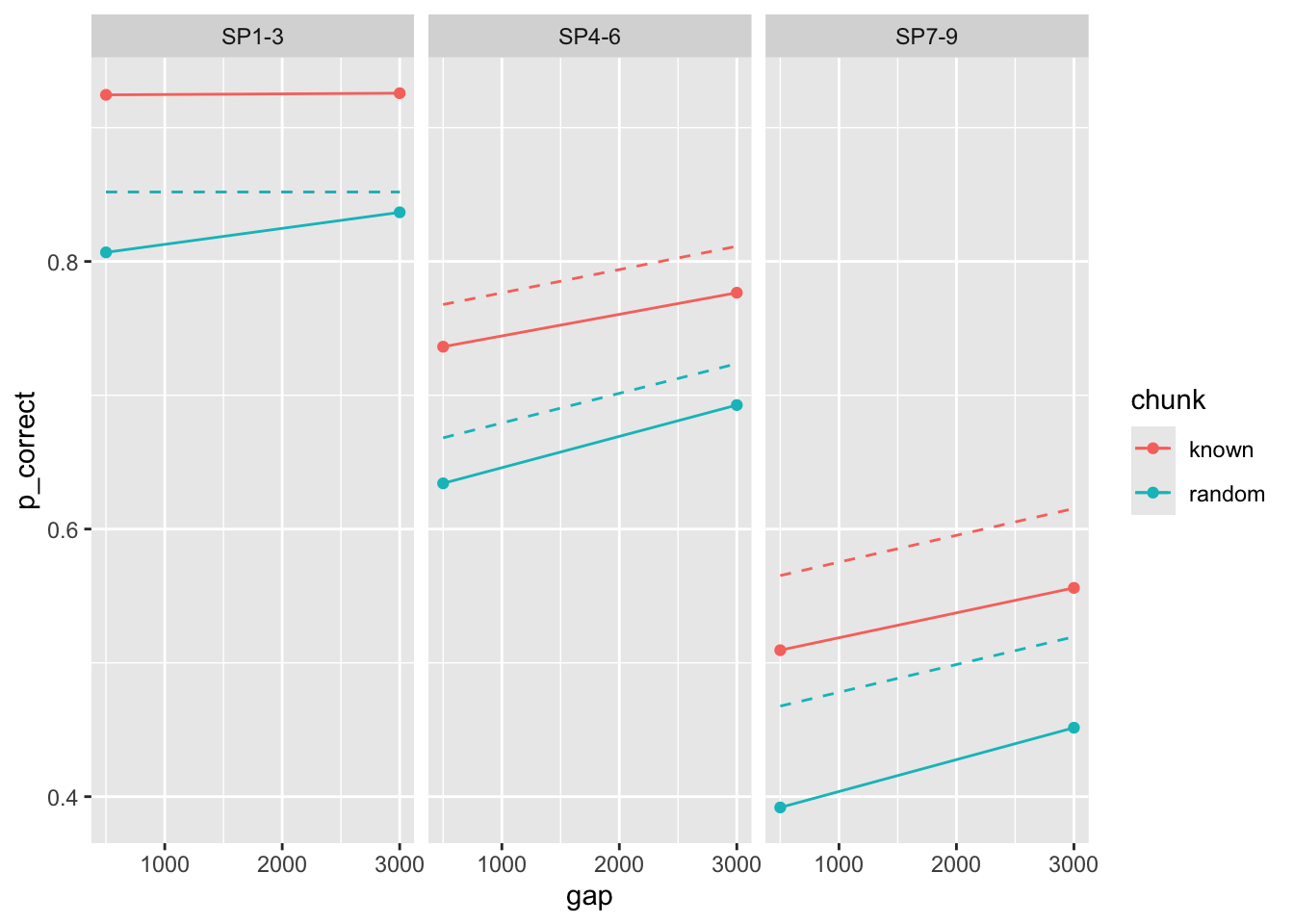
Strangely, there is a mismatch between these results and what is reported in the paper.

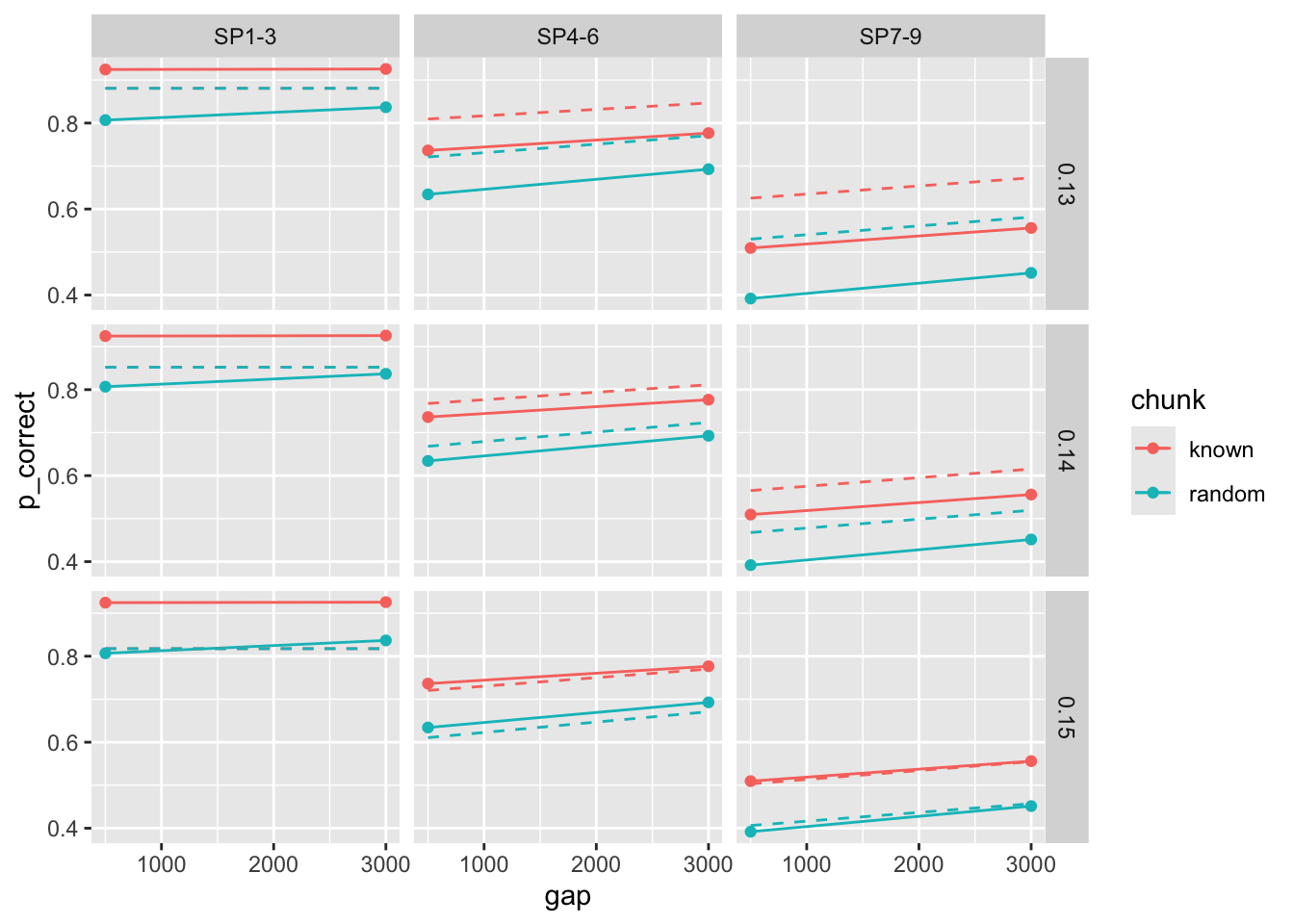
This is because the predictions are extremely sensitive to small changes in tau:

Code
params <- list(start, start, start)
params[[2]][["tau"]] <- 0.15
params[[3]][["tau"]] <- 0.13


overall_deviance(params[[1]], exp1_data_agg, by = c("chunk", "gap"), exclude_sp1 = TRUE)
[1] 116.5524
Code
overall_deviance(params[[2]], exp1_data_agg, by = c("chunk", "gap"), exclude_sp1 = TRUE)
[1] 38.11554
Code
overall_deviance(params[[3]], exp1_data_agg, by = c("chunk", "gap"), exclude_sp1 = TRUE)
[1] 395.7678
Code
exp1_data_agg$pred2 <- predict(params[[2]], data = exp1_data_agg, group_by = c("chunk", "gap"))
exp1_data_agg$pred3 <- predict(params[[3]], data = exp1_data_agg, group_by = c("chunk", "gap"))

exp1_data_agg |>
  pivot_longer(cols = starts_with("pred"), names_to = "tau", values_to = "pred") |>
  mutate(tau = case_when(
    tau == "pred" ~ "0.14",
    tau == "pred2" ~ "0.15",
    tau == "pred3" ~ "0.13"
  )) |>
  ggplot(aes(x = gap, y = p_correct, color = chunk)) +
  geom_point() +
  geom_line() +
  geom_line(aes(y = pred), linetype = "dashed") +
  facet_grid(tau ~ itemtype)
Back to top
Parameter identifiability
Experiment 3
Source Code
---
title: "Sensitivity to tau"
format: html
---

```{r}
#| label: init
#| message: false
library(tidyverse)
library(targets)
tar_source()
tar_load(exp1_data_agg)
```

In the current draft (May 12th), Eda modelled the data by ignoring the first chunk when calculating the likelihood.

Here are the predictions using the parameters reported in the paper:

```{r}
#| label: predictions
start <- paper_params()

exp1_data_agg$pred <- predict(start, data = exp1_data_agg, group_by = c("chunk", "gap"))

exp1_data_agg |>
  ggplot(aes(x = gap, y = p_correct, color = chunk)) +
  geom_point() +
  geom_line() +
  geom_line(aes(y = pred), linetype = "dashed") +
  facet_wrap(~itemtype)
```

Strangely, there is a mismatch between these results and what is reported in the paper.

This is because the predictions are extremely sensitive to small changes in tau:

```{r}
params <- list(start, start, start)
params[[2]][["tau"]] <- 0.15
params[[3]][["tau"]] <- 0.13


overall_deviance(params[[1]], exp1_data_agg, by = c("chunk", "gap"), exclude_sp1 = TRUE)
overall_deviance(params[[2]], exp1_data_agg, by = c("chunk", "gap"), exclude_sp1 = TRUE)
overall_deviance(params[[3]], exp1_data_agg, by = c("chunk", "gap"), exclude_sp1 = TRUE)

exp1_data_agg$pred2 <- predict(params[[2]], data = exp1_data_agg, group_by = c("chunk", "gap"))
exp1_data_agg$pred3 <- predict(params[[3]], data = exp1_data_agg, group_by = c("chunk", "gap"))

exp1_data_agg |>
  pivot_longer(cols = starts_with("pred"), names_to = "tau", values_to = "pred") |>
  mutate(tau = case_when(
    tau == "pred" ~ "0.14",
    tau == "pred2" ~ "0.15",
    tau == "pred3" ~ "0.13"
  )) |>
  ggplot(aes(x = gap, y = p_correct, color = chunk)) +
  geom_point() +
  geom_line() +
  geom_line(aes(y = pred), linetype = "dashed") +
  facet_grid(tau ~ itemtype)
```