Free time & chunking modeling
  • Versions
    • Latest
    • v0.1
  • Source Code
  • Report a Bug
  1. Notebooks
  2. Model 1: Original model
  3. Parameter identifiability
  • Version 0.1
  •  
  • About
  • Development notes
    • Notes
    • 2024-05-16 Meeting Notes
    • Extra primacy parameter
  • Notebooks
    • Data
      • View the data structure
      • Exploratory data analysis
      • Subject-level data
    • Model 1: Original model
      • Main results
      • Parameter identifiability
      • Sensitivity to tau
      • Experiment 3
      • Exploring model predictions
    • Model 2: Include encoding time
      • Main results
    • Model 3: Non-linear recovery
      • Explore model predictions
      • Basic fits
      • Bootstrapping data and fits for parameter uncertainty estimation
      • Extra primacy parameter
      • Linear recovery as a random variable
  • Function reference
    • Aggregate Data
    • Perform bootstrapped estimation
    • Calculate the deviance of a model
    • Get data object from a file
    • Generate a bootstrapped dataset
    • get_data function
    • Inverse Logit Transformation
    • Logit Transformation
    • Calculate the overall deviance
    • Plot Bootstrap Results
    • Plot Linear RV Recovery
    • Preprocesses the data
    • Execute an expression and save the result to a file or load the result from a file if it already exists.
    • Serial Recall Model

On this page

  • Overview
  • Fix rate to different values and explore the parameter space
    • Including SP1-3 in the fits
  • What about experiment 1?
  • Summary
  1. Notebooks
  2. Model 1: Original model
  3. Parameter identifiability

Parameter identifiability

  • Show All Code
  • Hide All Code

  • View Source

Overview

Code
library(tidyverse)
library(targets)
library(GGally)
library(kableExtra)
tar_source()

In the initial modeling notebook, I discovered some problems with parameter identifiability. Here I will explore this issue further.

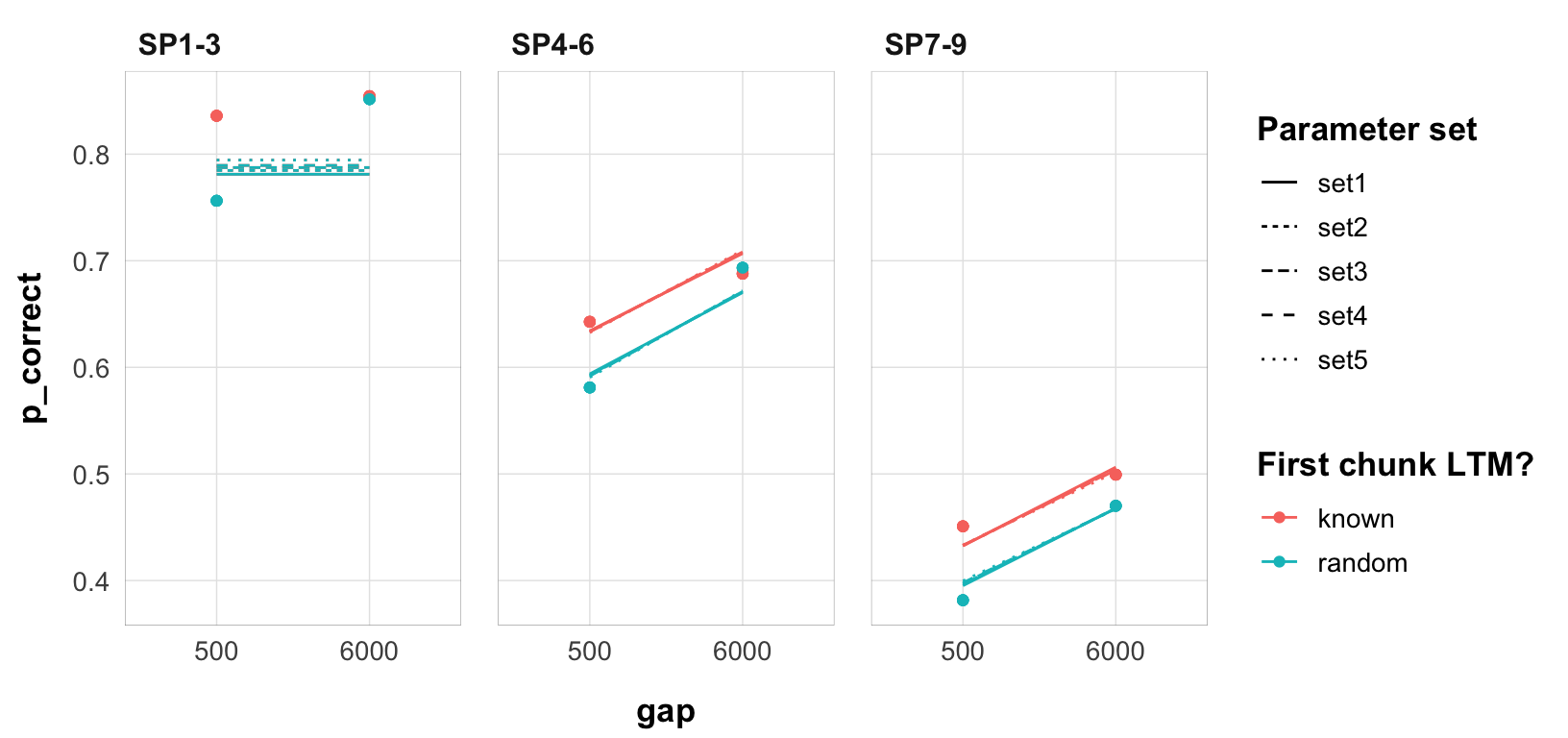
Initially I ran the model described in the May 13, 2024 draft with 100 different starting parameters. Here are 5 sets of very different best-fitting parameters that produce nearly identical fits as measured by the negative log-likelihood (deviance):

Code
fits <- readRDS("output/five_parsets_exp2.rds")
fits$set <- paste0("set", 1:5)

fits[, 1:6] |>
  as.data.frame() |>
  `rownames<-`(fits$set) |>
  kbl() %>%
  kable_styling()
prop prop_ltm rate tau gain deviance
set1 0.098 0.815 0.006 0.084 96.954 40.377
set2 0.132 0.818 0.009 0.108 54.078 40.429
set3 0.155 0.820 0.010 0.123 40.135 40.491
set4 0.173 0.822 0.011 0.133 32.738 40.556
set5 0.215 0.826 0.013 0.154 21.967 40.772

We can see that they all produce nearly identical predictions (the lines are the model predictions, the points are the data):

Code
fits |>
  mutate(pred = map2(fit, data, \(x, y) predict(x, y, group_by = c("chunk", "gap")))) |>
  unnest(c(data, pred)) |>
  mutate(gap = as.factor(gap)) |>
  ggplot(aes(x = gap, y = p_correct, color = chunk)) +
  geom_point() +
  geom_line(aes(y = pred, linetype = set, group = interaction(chunk, set))) +
  scale_color_discrete("First chunk LTM?") +
  scale_linetype_discrete("Parameter set") +
  facet_grid(~itemtype) +
  theme_pub()
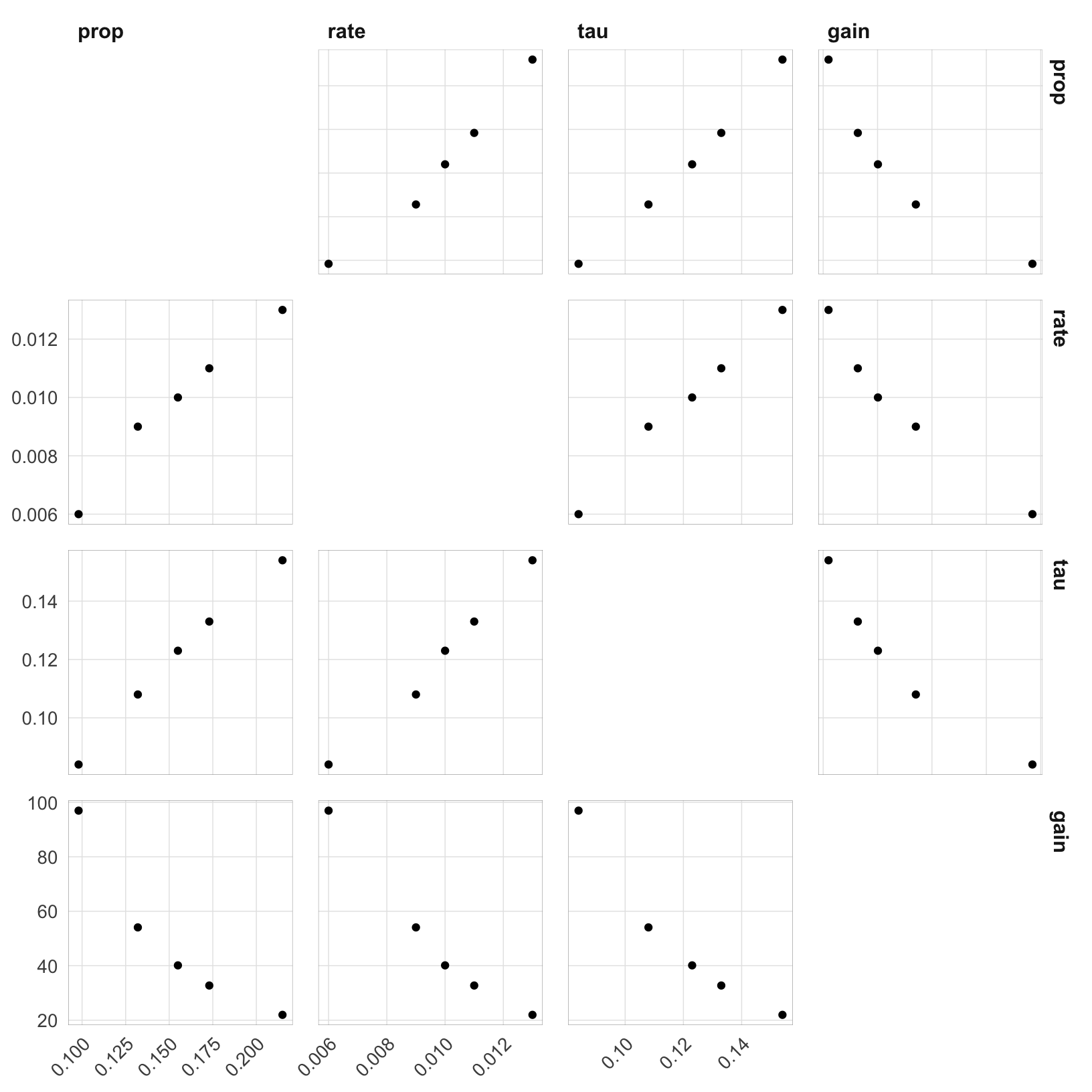
The plot below shows the strong nearly linear trade-offs between the parameters.

Code
fits |>
  select(prop, rate, tau, gain) |>
  ggpairs(
    diag = list(continuous = "blankDiag"),
    upper = list(continuous = "points")
  ) +
  theme_pub() +
  theme(axis.text.x = element_text(angle = 45, hjust = 1))
Fix rate to different values and explore the parameter space

I ran a simulation in which I fix1 the rate parameter to values in the range 0.005 to 0.2. I want to see if the identical fits extend to higher rates.

We first extract the best-fitting parameters for each rate from the 100 random start fits.

Code
tar_load(fits2)
fits2 <- fits2 |>
  mutate(
    deviance = pmap_dbl(list(fit, data, exclude_sp1), function(x, y, z) {
      overall_deviance(x$par, data = y, exclude_sp1 = z)
    }),
    rate = round(rate, 3)
  )


best <- fits2 |>
  group_by(rate, exp, exclude_sp1) |>
  filter(deviance == min(deviance)) |>
  slice(1) |>
  select(rate, prop, prop_ltm, tau, gain, deviance, fit, data) |>
  mutate(pred = map2(fit, data, \(x, y) predict(x, y, group_by = c("chunk", "gap")))) |>
  ungroup()
Adding missing grouping variables: `exp`, `exclude_sp1`

subset for exp2 and exclude_sp1 = TRUE

Code
best_subset <- filter(best, exp == 2, exclude_sp1)

From the deviance it’s already clear that the fits get wose once we get above 0.020 rate. Here are the best-fitting parameters for each rate:

Code
best_subset |>
  select(rate, prop, prop_ltm, tau, gain, deviance) |>
  mutate_all(round, 3) |>
  kbl() %>%
  kable_styling()
rate prop prop_ltm tau gain deviance
0.005 0.098 0.812 0.084 100.000 42.689
0.010 0.155 0.819 0.121 41.585 40.518
0.015 0.235 0.826 0.159 19.374 40.871
0.020 0.316 0.835 0.183 11.537 41.687
0.025 0.389 0.841 0.194 8.143 43.185
0.030 0.451 0.844 0.197 6.359 45.610
0.035 0.496 0.842 0.197 5.394 49.069
0.040 0.528 0.834 0.196 4.765 53.434
0.045 0.324 0.465 0.210 8.718 57.907
0.050 0.355 0.459 0.220 7.359 58.648
0.055 0.384 0.455 0.228 6.362 59.535
0.060 0.412 0.448 0.234 5.559 60.563
0.065 0.439 0.442 0.239 4.955 61.729
0.070 0.466 0.438 0.244 4.430 63.027
0.075 0.271 0.452 0.198 12.494 63.309
0.080 0.272 0.457 0.199 12.582 63.309
0.085 0.271 0.464 0.200 12.799 63.309
0.090 0.271 0.470 0.200 12.950 63.309
0.095 0.271 0.476 0.201 13.072 63.309
0.100 0.271 0.481 0.202 13.233 63.309

A few observations:

  1. with recovery rates higher than 0.07 the fits do no change much
  2. when the rate changes from 0.04 to 0.045, we switch to a different region of the parameter space. Similarly from 0.065 to 0.07
  3. looks like we have four ranges of rates with qualitative shifts:
    • 0.005 to 0.02: the fits are very similar and prop_ltm is ~ 0.8. The other parameters change proportionally to the rate
    • 0.025 to 0.04: fits get progressively worse. the other parameters still changes similarly to the first group, but tau is not stable. Seems like tau can no longer compensate, leading to worsening fits
    • 0.045 to 0.07: prop_ltm drops to ~0.45 and stays there. The other parameters again change proportionally to the rate, but they are now in a different region of the parameter space. Fits gradually worsen as we increase the rates
    • 0.07 to 0.2: prop is now stable at ~0.255. The other parameters change but with very small increments. Fits are identical

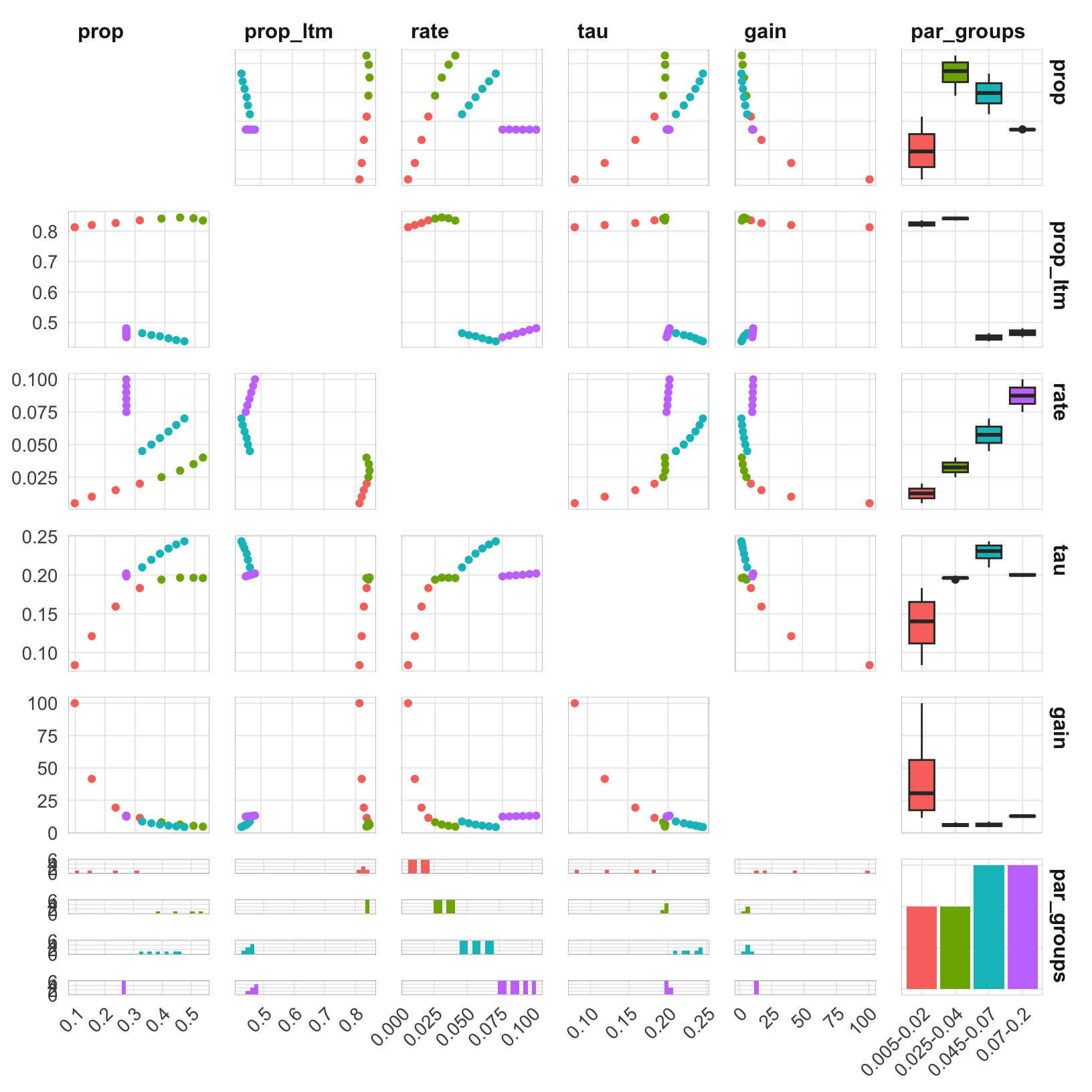
Here’s a pairs plot with colors indicating the rate group. The plot indicates that the parameter space does not have a smooth gradient, but rather jumps between regions when rate is fixed to different values.

Code
best_subset <- best_subset |>
  mutate(par_groups = case_when(
    rate <= 0.02 ~ "0.005-0.02",
    rate <= 0.04 ~ "0.025-0.04",
    rate <= 0.07 ~ "0.045-0.07",
    TRUE ~ "0.07-0.2"
  ))

best_subset |>
  select(prop, prop_ltm, rate, tau, gain, par_groups) |>
  ggpairs(
    aes(color = par_groups),
    diag = list(continuous = "blankDiag"),
    upper = list(continuous = "points")
  ) +
  theme_pub() +
  theme(axis.text.x = element_text(angle = 45, hjust = 1))
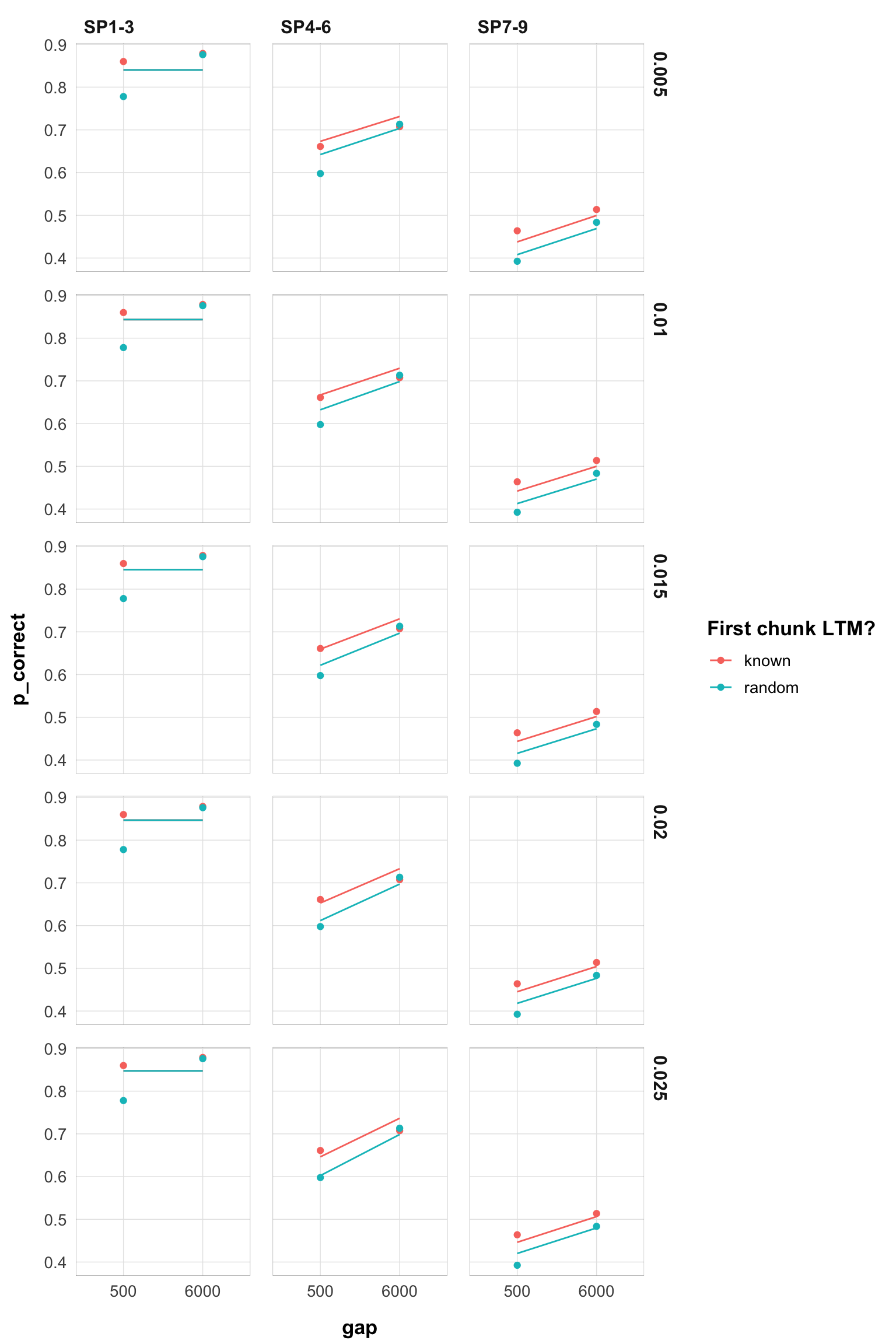
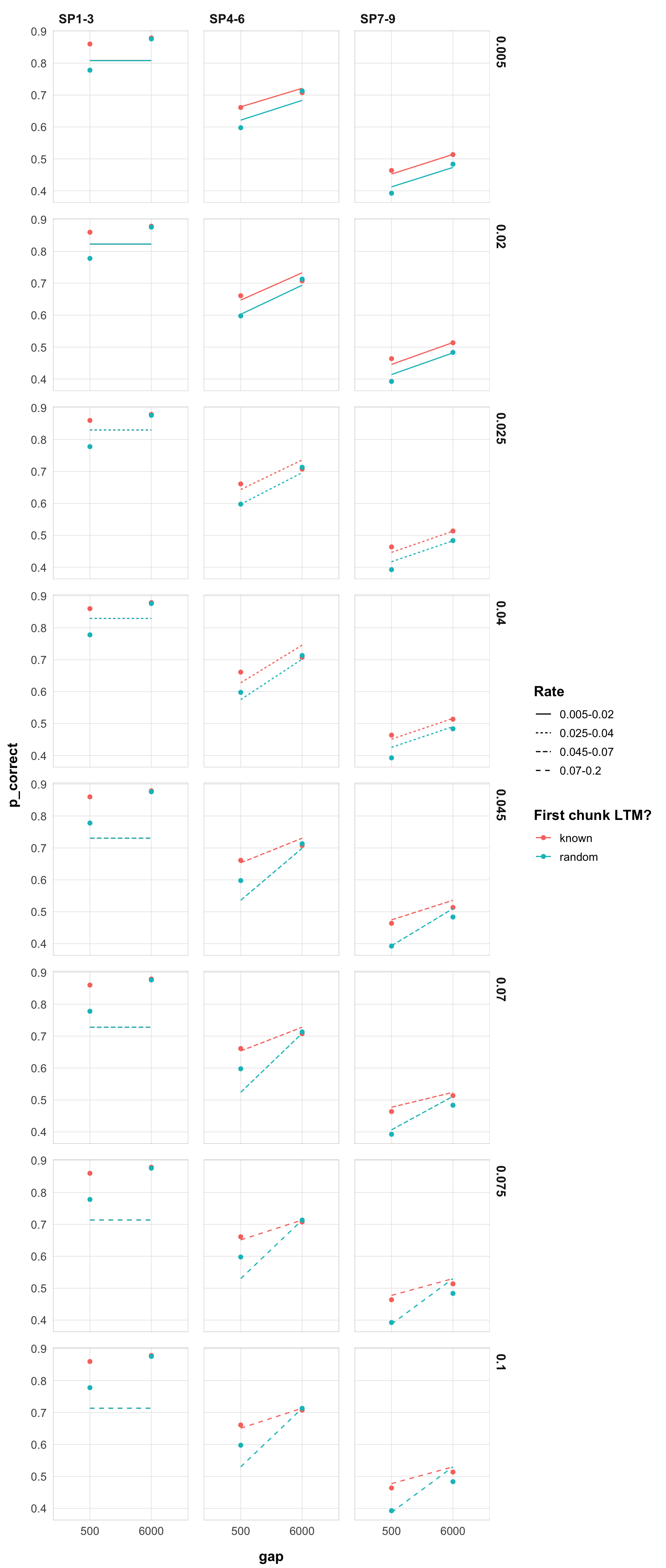
Let’s see how this affects the predictions for the different rate groups. It would be too much to plot all the predictions, so I will first plot the predictions for the first and last parameters for each rate group.

Code
best_subset |>
  group_by(par_groups) |>
  slice(c(1, n())) |>
  unnest(c(data, pred)) |>
  mutate(
    gap = as.factor(gap),
    rate = as.factor(round(rate, 3))
  ) |>
  ggplot(aes(x = gap, y = p_correct, color = chunk)) +
  geom_point() +
  geom_line(aes(y = pred, linetype = par_groups, group = interaction(chunk, rate))) +
  scale_color_discrete("First chunk LTM?") +
  scale_linetype_discrete("Rate") +
  facet_grid(rate ~ itemtype) +
  theme_pub()
A few observations:

  • Rates above 0.045 lead to the same fit, because they cause full recovery from first item to the second with 6 s ISI. We can see that from he plots because the prediction for SP1-3 and sp4-6 (6000 ISI) are the same for all rates above 0.045, meaning no serial position effect from the first to the second chunk. This is completely implausible, so we can rule out rates above 0.045.

Including SP1-3 in the fits

I will now include SP1-3 in the fits and see if this changes the parameter space.

Code
best_subset <- filter(best, exp == 2, exclude_sp1 == FALSE)

Here are the best-fitting parameters for each rate:

Code
best_subset |>
  select(rate, prop, prop_ltm, tau, gain, deviance) |>
  mutate_all(round, 3) |>
  kbl() %>%
  kable_styling()
rate prop prop_ltm tau gain deviance
0.005 0.109 0.875 0.091 92.939 119.499
0.010 0.216 0.869 0.149 24.963 114.013
0.015 0.303 0.867 0.176 13.406 110.780
0.020 0.374 0.863 0.189 9.213 109.681
0.025 0.432 0.860 0.193 7.153 110.370
0.030 0.481 0.859 0.193 5.961 112.559
0.035 0.527 0.857 0.191 5.106 116.055
0.040 0.567 0.853 0.187 4.514 120.700
0.045 0.602 0.853 0.183 4.074 126.391
0.050 0.640 0.852 0.177 3.679 133.024
0.055 0.667 0.853 0.172 3.429 140.578
0.060 0.697 0.852 0.166 3.181 148.930
0.065 0.723 0.852 0.161 2.992 158.062
0.070 0.749 0.851 0.155 2.811 167.905
0.075 0.773 0.853 0.148 2.660 178.428
0.080 0.793 0.854 0.143 2.537 189.595
0.085 0.816 0.852 0.136 2.405 201.389
0.090 0.836 0.854 0.130 2.300 213.730
0.095 0.855 0.855 0.124 2.203 226.585
0.100 0.873 0.855 0.118 2.115 239.930

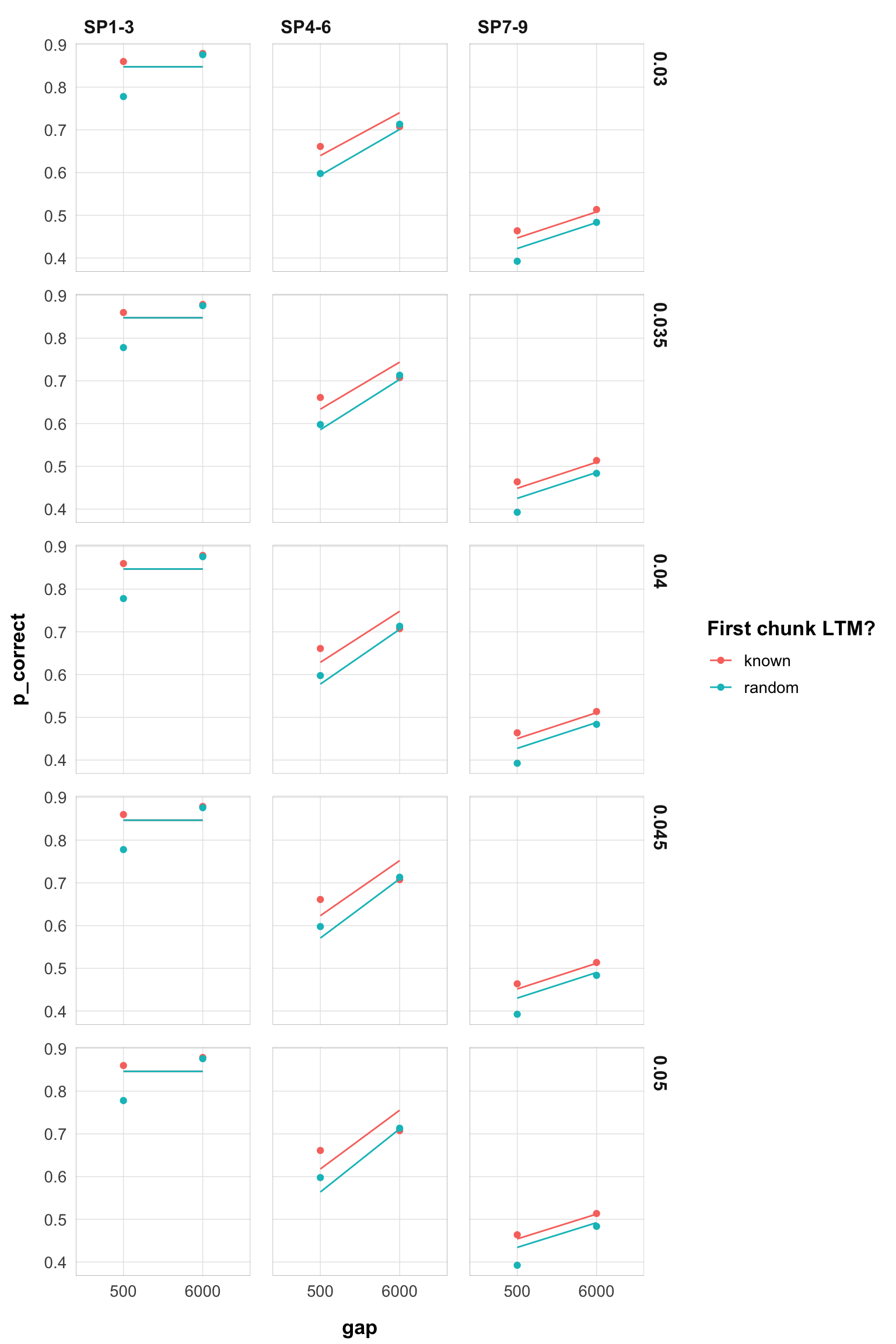
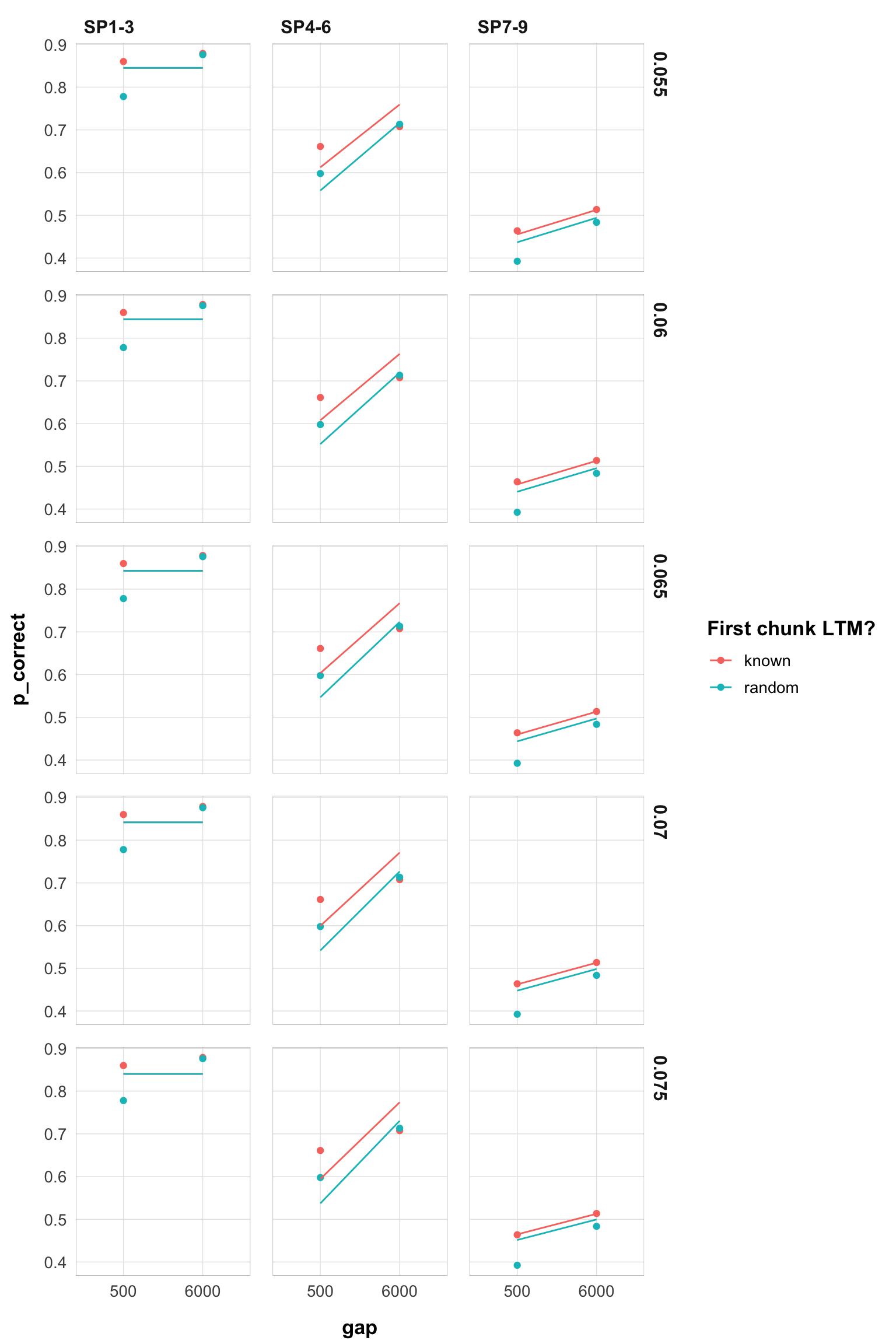
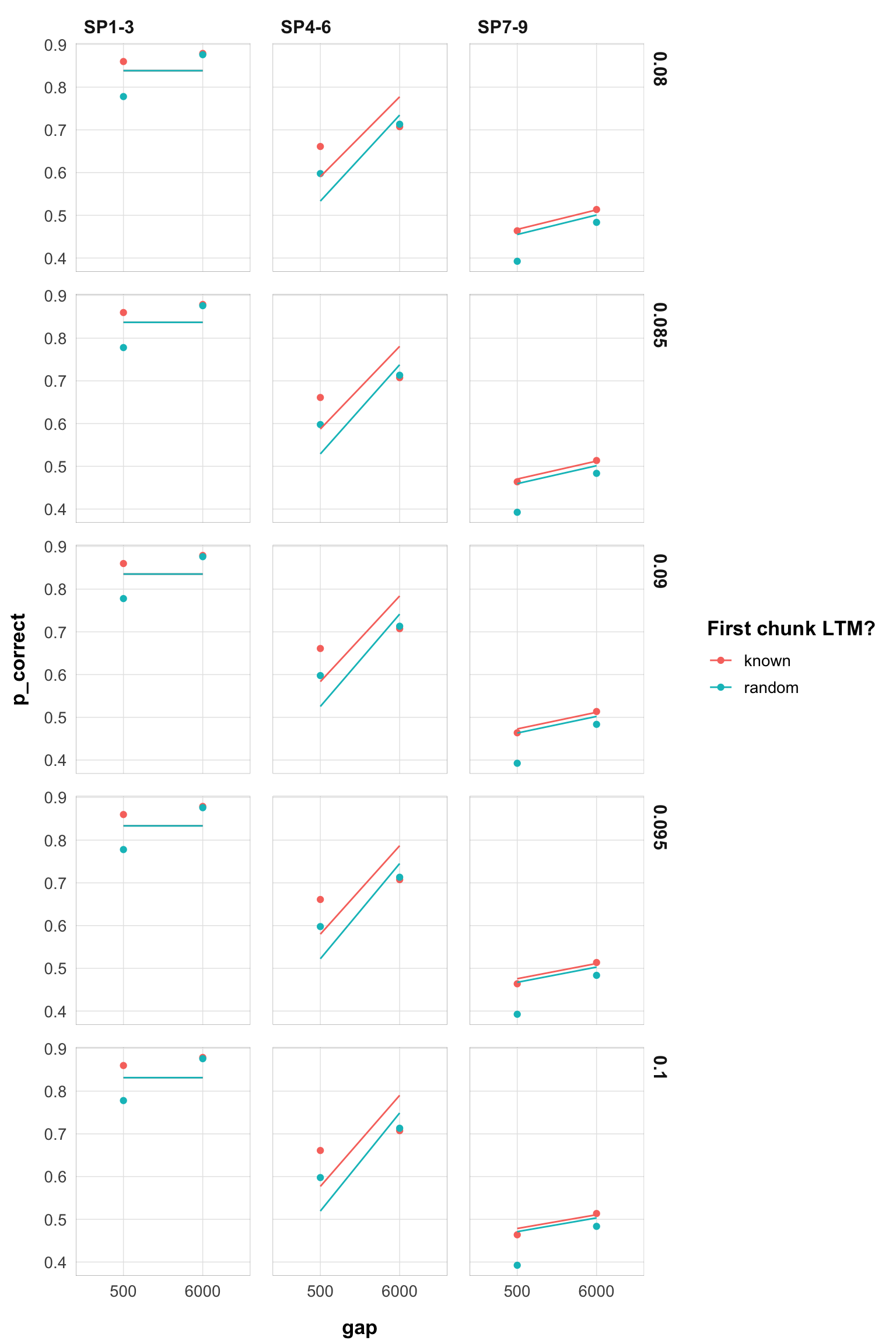
This now looks much more stable. Until 0.130 we don’t have switchest in the parameter region. Still, rates 0.005-0.03 are very similar.

Here are the plots for rates 0.005-0.10:

Code
pred_data <- best_subset |>
  unnest(c(data, pred)) |>
  mutate(
    gap = as.factor(gap),
    rate = round(rate, 3)
  )

myplot <- function(data) {
  ggplot(data, aes(x = gap, y = p_correct, color = chunk)) +
    geom_point() +
    geom_line(aes(y = pred, group = chunk)) +
    scale_color_discrete("First chunk LTM?") +
    facet_grid(rate ~ itemtype) +
    theme_pub()
}
  • Rate [0.005, 0.025]
  • Rate [0.03, 0.05]
  • Rate [0.055, 0.75]
  • Rate [0.08, 0.10]
Code
myplot(filter(pred_data, rate < 0.026))

Code
myplot(filter(pred_data, rate < 0.051 & rate > 0.029))
Code
myplot(filter(pred_data, rate < 0.076 & rate > 0.054))
Code
myplot(filter(pred_data, rate > 0.079, rate < 0.101))
What about experiment 1?

I will now repeat the same analysis for experiment 1.

Code
best_subset <- filter(best, exp == 1, exclude_sp1)

best_subset |>
  select(rate, prop, prop_ltm, tau, gain, deviance) |>
  mutate_all(round, 3) |>
  kbl() %>%
  kable_styling()
rate prop prop_ltm tau gain deviance
0.005 0.106 0.573 0.089 100.000 36.273
0.010 0.115 0.576 0.096 85.610 31.959
0.015 0.170 0.579 0.129 40.879 32.380
0.020 0.223 0.587 0.154 24.841 33.079
0.025 0.270 0.593 0.172 17.465 34.078
0.030 0.314 0.600 0.184 13.397 35.384
0.035 0.351 0.602 0.192 11.022 37.002
0.040 0.384 0.605 0.197 9.416 38.918
0.045 0.413 0.607 0.200 8.305 41.117
0.050 0.439 0.608 0.202 7.448 43.575
0.055 0.457 0.603 0.204 6.888 46.274
0.060 0.481 0.603 0.205 6.310 49.177
0.065 0.497 0.598 0.206 5.889 52.249
0.070 0.510 0.594 0.207 5.570 55.470
0.075 0.405 0.374 0.221 7.375 56.971
0.080 0.423 0.369 0.225 6.802 58.529
0.085 0.441 0.367 0.228 6.311 60.169
0.090 0.457 0.364 0.230 5.910 61.889
0.095 0.474 0.360 0.232 5.534 63.682
0.100 0.490 0.357 0.234 5.222 65.541

similar switch at 0.075 to a different region of the parameter space.

Here are the plots for rates 0.005-0.10:

Code
pred_data <- best_subset |>
  unnest(c(data, pred)) |>
  mutate(
    gap = as.factor(gap),
    rate = round(rate, 3)
  )
  • Rate [0.005, 0.025]
  • Rate [0.03, 0.05]
  • Rate [0.055, 0.75]
  • Rate [0.08, 0.10]
Code
myplot(filter(pred_data, rate < 0.026))

Code
myplot(filter(pred_data, rate < 0.051 & rate > 0.029))

Code
myplot(filter(pred_data, rate < 0.076 & rate > 0.054))

Code
myplot(filter(pred_data, rate > 0.079, rate < 0.101))

so even a rate of 0.07 does not necessarily predict a big interaction

Summary

  • The parameter space is not smooth, but rather jumps between regions when rate is fixed to different values
  • There are ridges in the parameter space where the fits are very similar
Back to top

Footnotes

  1. technically, I put a really narrow prior Normal(value, 0.0001) on the rate parameter rather than fixing it just because I can do it in the existing code.↩︎

Main results
Sensitivity to tau
Source Code
---
title: "Parameter identifiability"
format: 
  html:
    html-table-processing: none
---

## Overview

```{r}
#| label: init
#| message: false
library(tidyverse)
library(targets)
library(GGally)
library(kableExtra)
tar_source()
```

In [the initial modeling notebook](modelling_edas_approach.qmd#problem-with-parameter-identifiability), I discovered some problems with parameter identifiability. Here I will explore this issue further.

Initially I ran the model described in the May 13, 2024 draft with 100 different starting parameters. Here are 5 sets of very different best-fitting parameters that produce nearly identical fits as measured by the negative log-likelihood (deviance):

```{r}
#| label: parsets
fits <- readRDS("output/five_parsets_exp2.rds")
fits$set <- paste0("set", 1:5)

fits[, 1:6] |>
  as.data.frame() |>
  `rownames<-`(fits$set) |>
  kbl() %>%
  kable_styling()
```

We can see that they all produce nearly identical predictions (the lines are the model predictions, the points are the data):

```{r}
#| label: plot five fits
#| fig-width: 8.5
#| fig-height: 4
fits |>
  mutate(pred = map2(fit, data, \(x, y) predict(x, y, group_by = c("chunk", "gap")))) |>
  unnest(c(data, pred)) |>
  mutate(gap = as.factor(gap)) |>
  ggplot(aes(x = gap, y = p_correct, color = chunk)) +
  geom_point() +
  geom_line(aes(y = pred, linetype = set, group = interaction(chunk, set))) +
  scale_color_discrete("First chunk LTM?") +
  scale_linetype_discrete("Parameter set") +
  facet_grid(~itemtype) +
  theme_pub()
```

The plot below shows the strong nearly linear trade-offs between the parameters.

```{r}
#| label: plot par correlations
#| fig-width: 8.5
#| fig-height: 8.5
fits |>
  select(prop, rate, tau, gain) |>
  ggpairs(
    diag = list(continuous = "blankDiag"),
    upper = list(continuous = "points")
  ) +
  theme_pub() +
  theme(axis.text.x = element_text(angle = 45, hjust = 1))
```

## Fix rate to different values and explore the parameter space

I ran a simulation in which I fix[^1] the rate parameter to values in the range 0.005 to 0.2. I want to see if the identical fits extend to higher rates.

[^1]: technically, I put a really narrow prior Normal(value, 0.0001) on the rate parameter rather than fixing it just because I can do it in the existing code.

We first extract the best-fitting parameters for each rate from the 100 random start fits.

```{r}
#| label: rate scan
tar_load(fits2)
fits2 <- fits2 |>
  mutate(
    deviance = pmap_dbl(list(fit, data, exclude_sp1), function(x, y, z) {
      overall_deviance(x$par, data = y, exclude_sp1 = z)
    }),
    rate = round(rate, 3)
  )


best <- fits2 |>
  group_by(rate, exp, exclude_sp1) |>
  filter(deviance == min(deviance)) |>
  slice(1) |>
  select(rate, prop, prop_ltm, tau, gain, deviance, fit, data) |>
  mutate(pred = map2(fit, data, \(x, y) predict(x, y, group_by = c("chunk", "gap")))) |>
  ungroup()
```

subset for exp2 and exclude_sp1 = TRUE

```{r}
#| label: subset best
best_subset <- filter(best, exp == 2, exclude_sp1)
```

From the deviance it's already clear that the fits get wose once we get above 0.020 rate. Here are the best-fitting parameters for each rate:

```{r}
#| label: best fits
best_subset |>
  select(rate, prop, prop_ltm, tau, gain, deviance) |>
  mutate_all(round, 3) |>
  kbl() %>%
  kable_styling()
```

A few observations:

1) with recovery rates higher than 0.07 the fits do no change much
2) when the rate changes from 0.04 to 0.045, we switch to a different region of the parameter space. Similarly from 0.065 to 0.07
3) looks like we have four ranges of rates with qualitative shifts:
     - ***0.005 to 0.02:*** the fits are very similar and prop_ltm is ~ 0.8. The other parameters change proportionally to the rate
     - ***0.025 to 0.04:*** fits get progressively worse. the other parameters still changes similarly to the first group, but tau is not stable. Seems like tau can no longer compensate, leading to worsening fits
     - ***0.045 to 0.07:*** prop_ltm drops to ~0.45 and stays there. The other parameters again change proportionally to the rate, but they are now in a different region of the parameter space. Fits gradually worsen as we increase the rates
     - ***0.07 to 0.2:*** prop is now stable at ~0.255. The other parameters change but with very small increments. Fits are identical

Here's a pairs plot with colors indicating the rate group. The plot indicates that the parameter space does not have a smooth gradient, but rather jumps between regions when rate is fixed to different values.

```{r}
#| label: plot rate correlations
#| message: false
#| fig-width: 8.5
#| fig-height: 8.5
best_subset <- best_subset |>
  mutate(par_groups = case_when(
    rate <= 0.02 ~ "0.005-0.02",
    rate <= 0.04 ~ "0.025-0.04",
    rate <= 0.07 ~ "0.045-0.07",
    TRUE ~ "0.07-0.2"
  ))

best_subset |>
  select(prop, prop_ltm, rate, tau, gain, par_groups) |>
  ggpairs(
    aes(color = par_groups),
    diag = list(continuous = "blankDiag"),
    upper = list(continuous = "points")
  ) +
  theme_pub() +
  theme(axis.text.x = element_text(angle = 45, hjust = 1))
```

Let's see how this affects the predictions for the different rate groups. It would be too much to plot all the predictions, so I will first plot the predictions for the first and last parameters for each rate group.

```{r}
#| label: plot rate fits
#| fig-width: 8.5
#| fig-height: 20
best_subset |>
  group_by(par_groups) |>
  slice(c(1, n())) |>
  unnest(c(data, pred)) |>
  mutate(
    gap = as.factor(gap),
    rate = as.factor(round(rate, 3))
  ) |>
  ggplot(aes(x = gap, y = p_correct, color = chunk)) +
  geom_point() +
  geom_line(aes(y = pred, linetype = par_groups, group = interaction(chunk, rate))) +
  scale_color_discrete("First chunk LTM?") +
  scale_linetype_discrete("Rate") +
  facet_grid(rate ~ itemtype) +
  theme_pub()
```

A few observations:

- Rates above 0.045 lead to the same fit, because they cause full recovery from first item to the second with 6 s ISI. We can see that from he plots because the prediction for SP1-3 and sp4-6 (6000 ISI) are the same for all rates above 0.045, meaning no serial position effect from the first to the second chunk. This is completely implausible, so we can rule out rates above 0.045.

### Including SP1-3 in the fits

I will now include SP1-3 in the fits and see if this changes the parameter space.

```{r}
#| label: include sp1
best_subset <- filter(best, exp == 2, exclude_sp1 == FALSE)
```

Here are the best-fitting parameters for each rate:

```{r}
#| label: best fits sp1
best_subset |>
  select(rate, prop, prop_ltm, tau, gain, deviance) |>
  mutate_all(round, 3) |>
  kbl() %>%
  kable_styling()
```

This now looks much more stable. Until 0.130 we don't have switchest in the parameter region. Still, rates 0.005-0.03 are very similar.

Here are the plots for rates 0.005-0.10:

```{r}
#| label: plot rate fits sp1
#| fig-width: 8.5
#| fig-height: 20
pred_data <- best_subset |>
  unnest(c(data, pred)) |>
  mutate(
    gap = as.factor(gap),
    rate = round(rate, 3)
  )

myplot <- function(data) {
  ggplot(data, aes(x = gap, y = p_correct, color = chunk)) +
    geom_point() +
    geom_line(aes(y = pred, group = chunk)) +
    scale_color_discrete("First chunk LTM?") +
    facet_grid(rate ~ itemtype) +
    theme_pub()
}
```

::: {.panel-tabset}

## Rate [0.005, 0.025]

```{r}
#| label: plot rate fits sp1 1
#| fig-width: 8
#| fig-height: 12
myplot(filter(pred_data, rate < 0.026))
```

## Rate [0.03, 0.05]

```{r}
#| label: plot rate fits sp1 2
#| fig-width: 8
#| fig-height: 12
#| message: false
myplot(filter(pred_data, rate < 0.051 & rate > 0.029))
```

## Rate [0.055, 0.75]

```{r}
#| label: plot rate fits sp1 3
#| fig-width: 8
#| fig-height: 12
#| message: false
myplot(filter(pred_data, rate < 0.076 & rate > 0.054))
```

## Rate [0.08, 0.10]

```{r}
#| label: plot rate fits sp1 4
#| fig-width: 8
#| fig-height: 12
#| message: false
myplot(filter(pred_data, rate > 0.079, rate < 0.101))
```

:::

## What about experiment 1?

I will now repeat the same analysis for experiment 1.

```{r}
#| label: exp1
best_subset <- filter(best, exp == 1, exclude_sp1)

best_subset |>
  select(rate, prop, prop_ltm, tau, gain, deviance) |>
  mutate_all(round, 3) |>
  kbl() %>%
  kable_styling()
```

similar switch at 0.075 to a different region of the parameter space. 

Here are the plots for rates 0.005-0.10:

```{r}
#| label: plot rate fits exp1
#| fig-width: 8.5
#| fig-height: 20

pred_data <- best_subset |>
  unnest(c(data, pred)) |>
  mutate(
    gap = as.factor(gap),
    rate = round(rate, 3)
  )
```


::: {.panel-tabset}

## Rate [0.005, 0.025]

```{r}
#| label: plot rate fits 1 (exp1)
#| fig-width: 8
#| fig-height: 12
myplot(filter(pred_data, rate < 0.026))
```

## Rate [0.03, 0.05]

```{r}
#| label: plot rate fits 2 (exp1)
#| fig-width: 8
#| fig-height: 12
#| message: false
myplot(filter(pred_data, rate < 0.051 & rate > 0.029))
```

## Rate [0.055, 0.75]

```{r}
#| label: plot rate fits 3 (exp1)
#| fig-width: 8
#| fig-height: 12
#| message: false
myplot(filter(pred_data, rate < 0.076 & rate > 0.054))
```

## Rate [0.08, 0.10]

```{r}
#| label: plot rate fits 4 (exp1)
#| fig-width: 8
#| fig-height: 12
#| message: false
myplot(filter(pred_data, rate > 0.079, rate < 0.101))
```

:::

so even a rate of 0.07 does not necessarily predict a big interaction

## Summary

- The parameter space is not smooth, but rather jumps between regions when rate is fixed to different values
- There are ridges in the parameter space where the fits are very similar