Free time & chunking modeling
  • Versions
    • Latest
    • v0.1
  • Source Code
  • Report a Bug
  1. Notebooks
  2. Data
  3. Exploratory data analysis
  • Version 0.1
  •  
  • About
  • Development notes
    • Notes
    • 2024-05-16 Meeting Notes
    • Extra primacy parameter
  • Notebooks
    • Data
      • View the data structure
      • Exploratory data analysis
      • Subject-level data
    • Model 1: Original model
      • Main results
      • Parameter identifiability
      • Sensitivity to tau
      • Experiment 3
      • Exploring model predictions
    • Model 2: Include encoding time
      • Main results
    • Model 3: Non-linear recovery
      • Explore model predictions
      • Basic fits
      • Bootstrapping data and fits for parameter uncertainty estimation
      • Extra primacy parameter
      • Linear recovery as a random variable
  • Function reference
    • Aggregate Data
    • Perform bootstrapped estimation
    • Calculate the deviance of a model
    • Get data object from a file
    • Generate a bootstrapped dataset
    • get_data function
    • Inverse Logit Transformation
    • Logit Transformation
    • Calculate the overall deviance
    • Plot Bootstrap Results
    • Plot Linear RV Recovery
    • Preprocesses the data
    • Execute an expression and save the result to a file or load the result from a file if it already exists.
    • Serial Recall Model

On this page

  • Overview
  • Overall performance
  • Individual performance
  • Experiment 3
  • Recall times
  1. Notebooks
  2. Data
  3. Exploratory data analysis

Exploratory data analysis

  • Show All Code
  • Hide All Code

  • View Source

Overview

Code
library(tidyverse)
library(targets)
library(ggdist)
tar_source()
tar_load(c(exp1_data, exp2_data, exp1_data_agg, exp2_data_agg, exp3_data, exp3_data_agg))

data_agg <- bind_rows(
  mutate(exp1_data_agg, exp = "Exp 1"),
  mutate(exp2_data_agg, exp = "Exp 2")
)

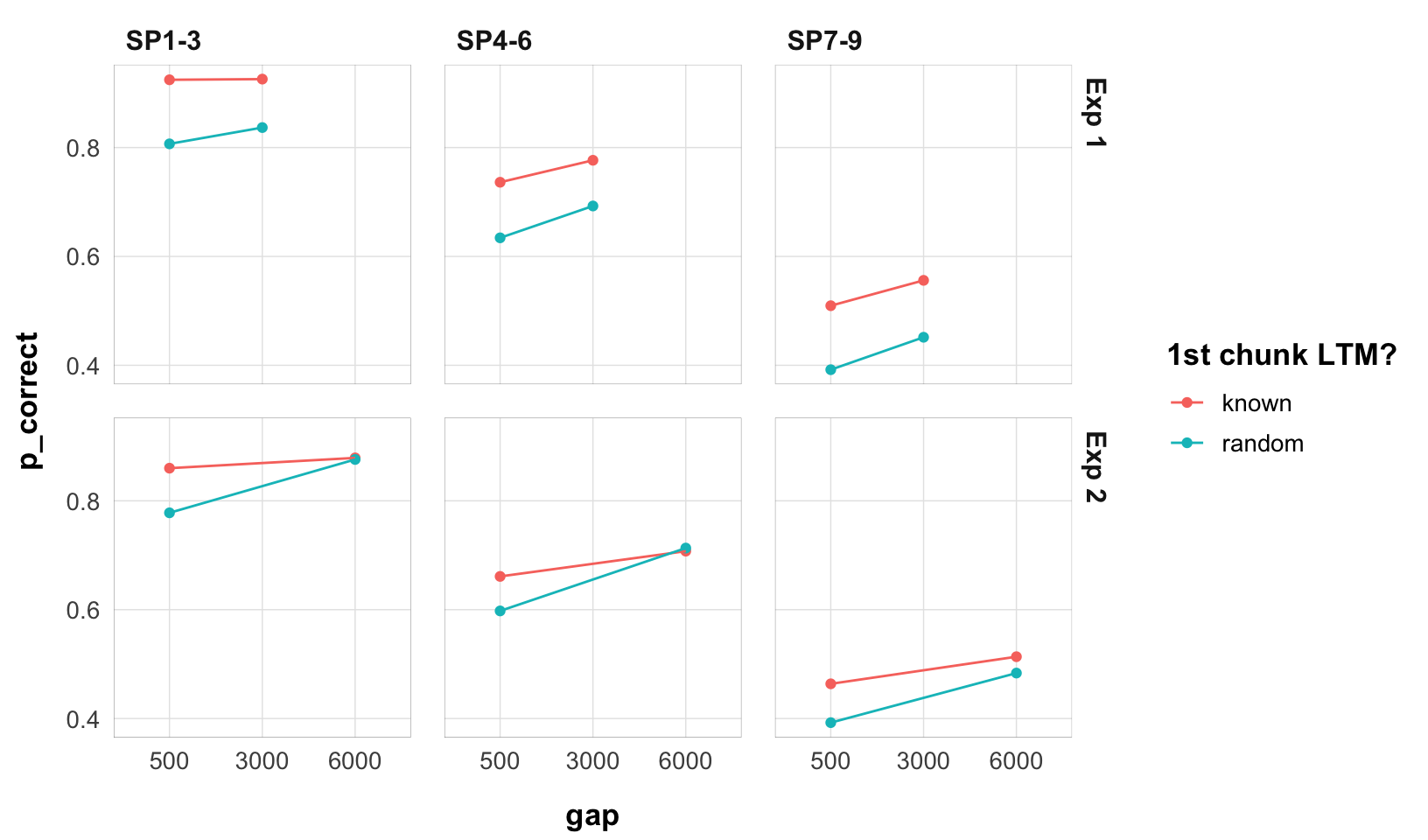
Here I have a bunch of plots to help me understand the data for the later modeling.

Overall performance

Code
data_agg |>
  mutate(gap = as.factor(gap)) |>
  ggplot(aes(gap, p_correct, color = chunk, group = chunk)) +
  geom_point() +
  geom_line() +
  scale_color_discrete("1st chunk LTM?") +
  facet_grid(exp ~ itemtype) +
  theme_pub()

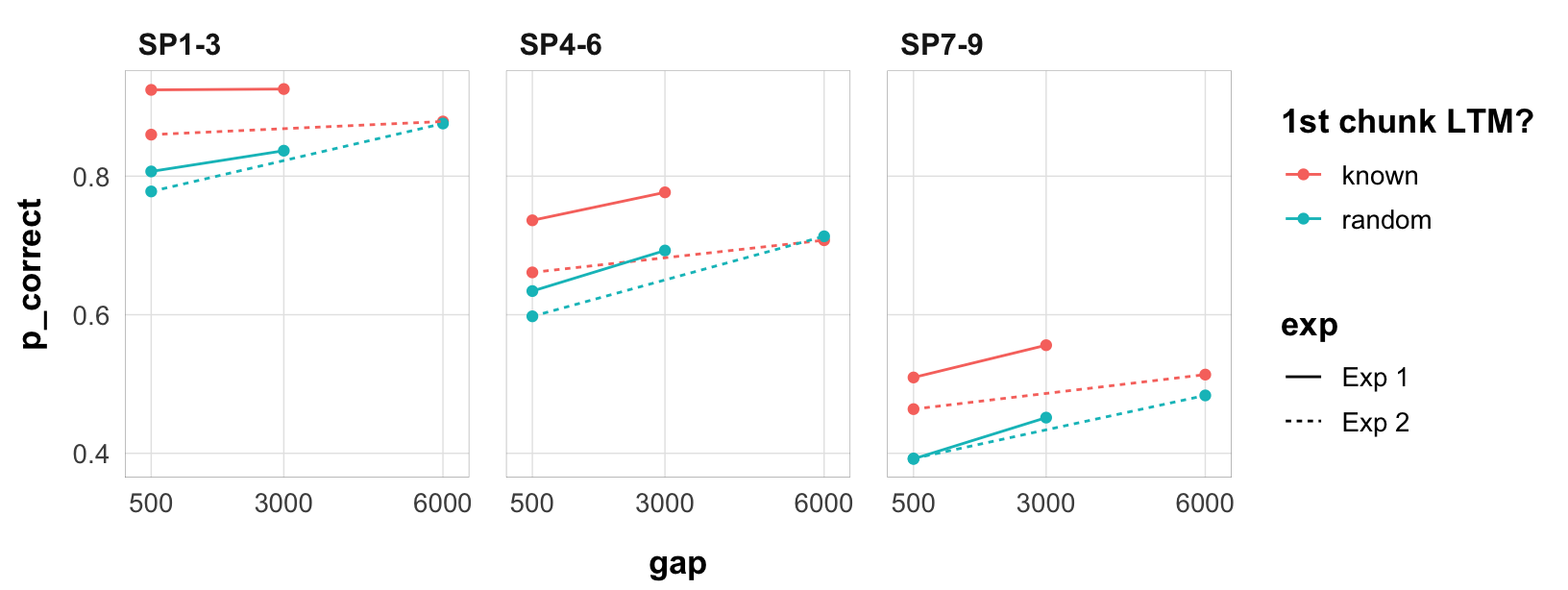
Together to compare shared levels:

Code
data_agg |>
  ggplot(aes(gap, p_correct, color = chunk, linetype = exp)) +
  geom_point() +
  geom_line() +
  scale_color_discrete("1st chunk LTM?") +
  scale_x_continuous(breaks = c(500, 3000, 6000)) +
  coord_cartesian(xlim = c(300, 6200)) +
  facet_wrap(~itemtype) +
  theme_pub()

Overall performance is a bit lower in experiment 2, but not by much. Still, it might be an issue if trying to model the two experiments together. The effect size of the chunk is also smaller.

Individual performance

Code
data_agg_subj <- bind_rows(
  mutate(exp1_data, exp = "Exp 1"),
  mutate(exp2_data, exp = "Exp 2")
) |>
  group_by(id, exp) |>
  nest() |>
  mutate(data = map(data, aggregate_data)) |>
  unnest(data)

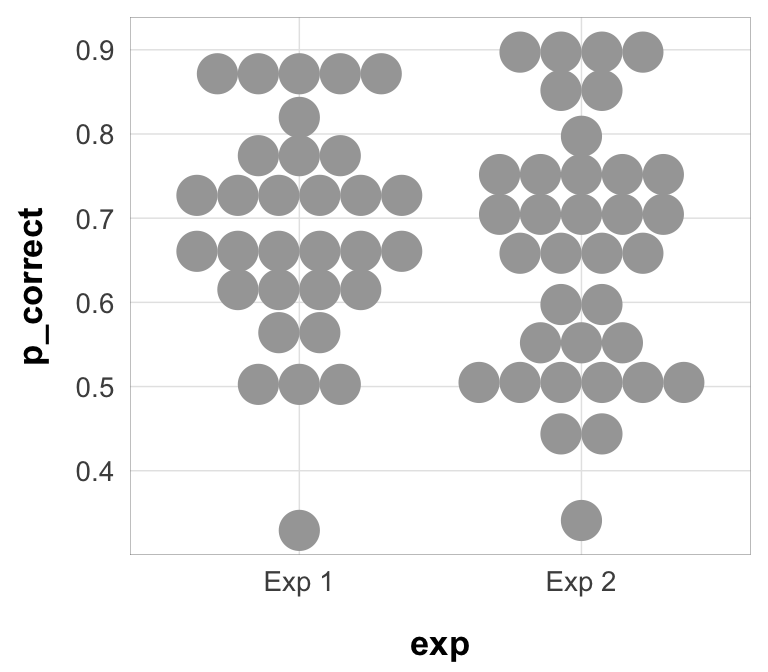
print overall accuracy for each subject:

Code
data_agg_subj |>
  group_by(exp, id) |>
  summarize(p_correct = mean(p_correct)) |>
  ggplot(aes(exp, p_correct)) +
  geom_dotsinterval(side = "both") +
  theme_pub()

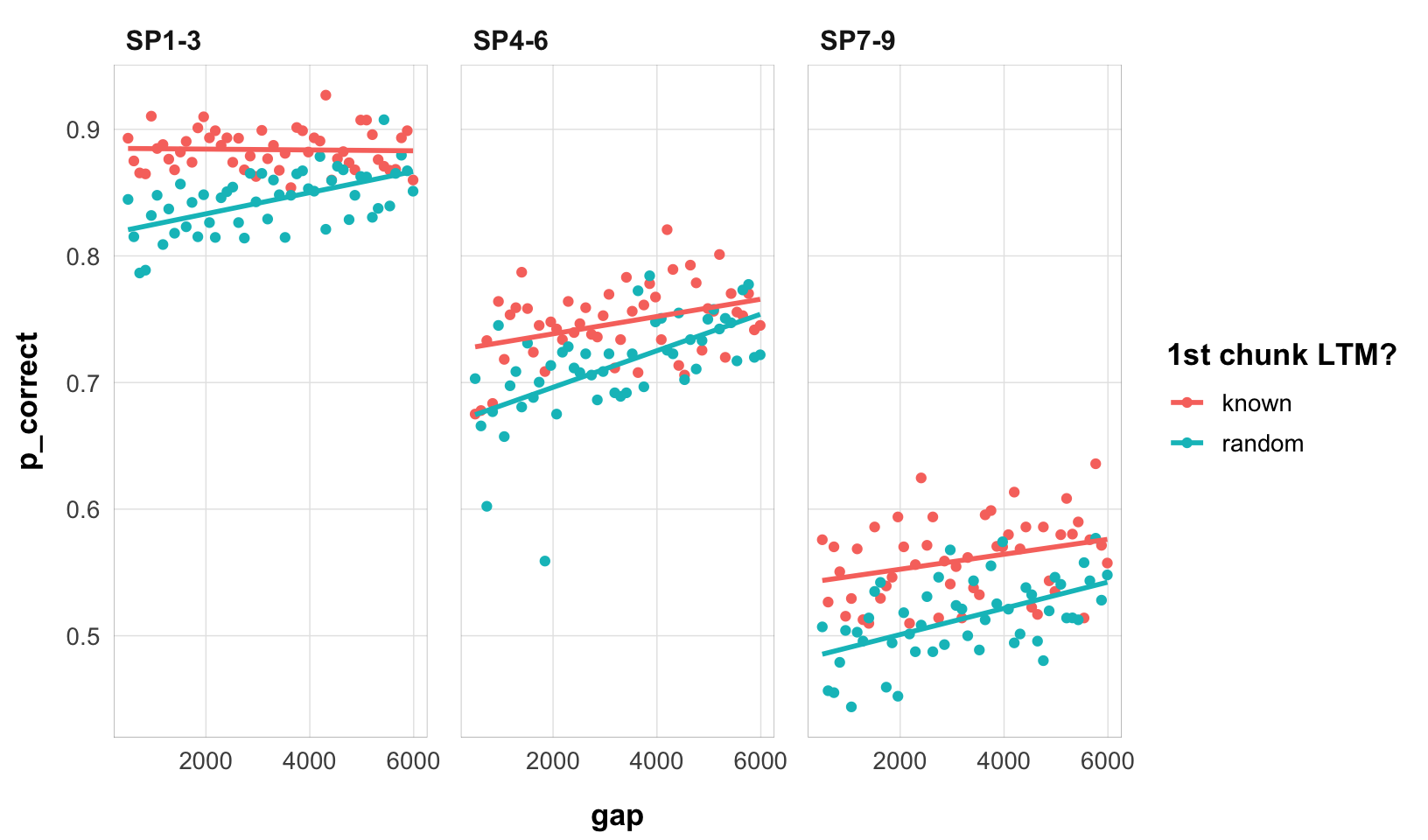
Experiment 3

Code
exp3_data_agg |>
  ggplot(aes(gap, p_correct, color = chunk, group = chunk)) +
  geom_point() +
  stat_smooth(method = "lm", se = FALSE) +
  scale_color_discrete("1st chunk LTM?") +
  facet_wrap(~itemtype) +
  theme_pub()
`geom_smooth()` using formula = 'y ~ x'

Recall times

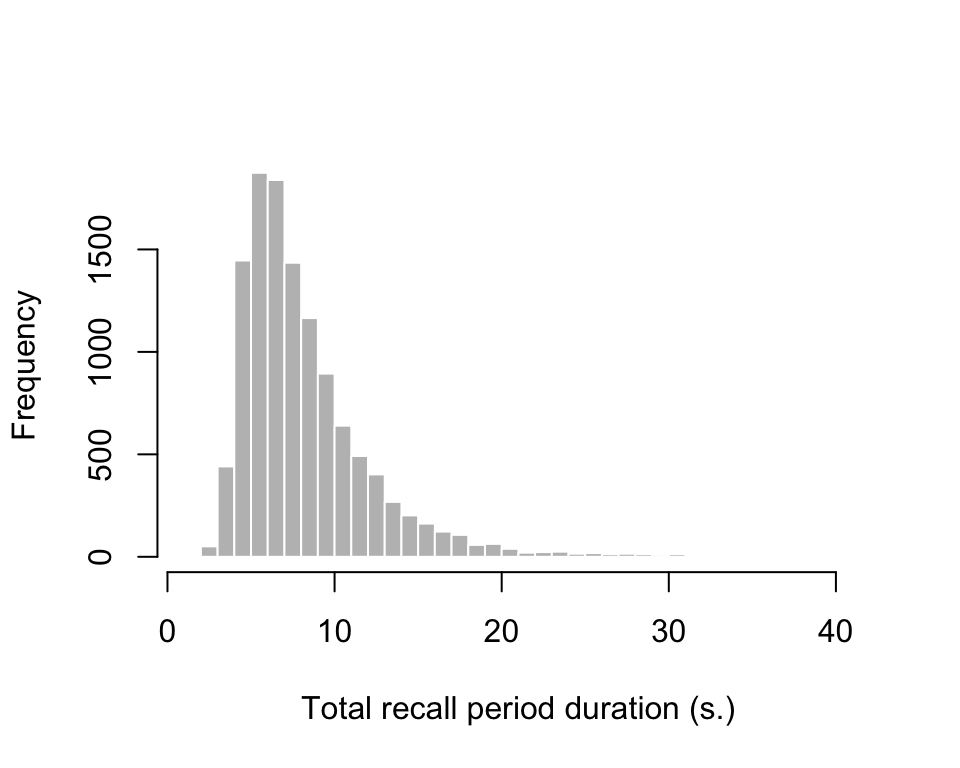
This is the distribution of total recall period duration for experiment 3:

Code
total_rts <- exp3_data |>
  group_by(id, trial) |>
  summarize(total_recall_duration = sum(rt) + 9 * 0.2) |>
  pluck("total_recall_duration")
`summarise()` has grouped output by 'id'. You can override using the `.groups` argument.
Code
hist(total_rts, breaks = 30, col = "grey", border = "white", xlab = "Total recall period duration (s.)", main = "")

Back to top
View the data structure
Subject-level data
Source Code
---
title: "Exploratory data analysis"
format: html
---

## Overview

```{r}
#| label: init
#| message: false
library(tidyverse)
library(targets)
library(ggdist)
tar_source()
tar_load(c(exp1_data, exp2_data, exp1_data_agg, exp2_data_agg, exp3_data, exp3_data_agg))

data_agg <- bind_rows(
  mutate(exp1_data_agg, exp = "Exp 1"),
  mutate(exp2_data_agg, exp = "Exp 2")
)

```

Here I have a bunch of plots to help me understand the data for the later modeling.

## Overall performance

```{r}
#| label: overall_performance_exp1
#| fig-width: 8.5
#| fig-height: 5
data_agg |>
  mutate(gap = as.factor(gap)) |>
  ggplot(aes(gap, p_correct, color = chunk, group = chunk)) +
  geom_point() +
  geom_line() +
  scale_color_discrete("1st chunk LTM?") +
  facet_grid(exp ~ itemtype) +
  theme_pub()
```

Together to compare shared levels:

```{r}
#| label: overall_performance_exp1_shared_levels
#| fig-width: 8.5
#| fig-height: 3.2
data_agg |>
  ggplot(aes(gap, p_correct, color = chunk, linetype = exp)) +
  geom_point() +
  geom_line() +
  scale_color_discrete("1st chunk LTM?") +
  scale_x_continuous(breaks = c(500, 3000, 6000)) +
  coord_cartesian(xlim = c(300, 6200)) +
  facet_wrap(~itemtype) +
  theme_pub()
```

Overall performance is a bit lower in experiment 2, but not by much. Still, it might be an issue if trying to model the two experiments together. The effect size of the chunk is also smaller.

## Individual performance

```{r}
#| label: agg_data_subj
#| message: false
data_agg_subj <- bind_rows(
  mutate(exp1_data, exp = "Exp 1"),
  mutate(exp2_data, exp = "Exp 2")
) |>
  group_by(id, exp) |>
  nest() |>
  mutate(data = map(data, aggregate_data)) |>
  unnest(data)
```

print overall accuracy for each subject:

```{r}
#| label: overall_accuracy
#| fig-width: 4
#| fig-height: 3.5
#| message: false
data_agg_subj |>
  group_by(exp, id) |>
  summarize(p_correct = mean(p_correct)) |>
  ggplot(aes(exp, p_correct)) +
  geom_dotsinterval(side = "both") +
  theme_pub()

```

## Experiment 3

```{r}
#| label: exp3_performance
#| fig-width: 8.5
#| fig-height: 5
exp3_data_agg |>
  ggplot(aes(gap, p_correct, color = chunk, group = chunk)) +
  geom_point() +
  stat_smooth(method = "lm", se = FALSE) +
  scale_color_discrete("1st chunk LTM?") +
  facet_wrap(~itemtype) +
  theme_pub()
```

## Recall times

This is the distribution of total recall period duration for experiment 3:

```{r}
#| label: recall_times
#| fig-width: 5
#| fig-height: 4
total_rts <- exp3_data |>
  group_by(id, trial) |>
  summarize(total_recall_duration = sum(rt) + 9 * 0.2) |>
  pluck("total_recall_duration")

hist(total_rts, breaks = 30, col = "grey", border = "white", xlab = "Total recall period duration (s.)", main = "")

```