Free time & chunking modeling
  • Versions
    • Latest
    • v0.1
  • Source Code
  • Report a Bug
  1. Notebooks
  2. Model 3: Non-linear recovery
  3. Basic fits
  • Version 0.1
  •  
  • About
  • Development notes
    • Notes
    • 2024-05-16 Meeting Notes
    • Extra primacy parameter
  • Notebooks
    • Data
      • View the data structure
      • Exploratory data analysis
      • Subject-level data
    • Model 1: Original model
      • Main results
      • Parameter identifiability
      • Sensitivity to tau
      • Experiment 3
      • Exploring model predictions
    • Model 2: Include encoding time
      • Main results
    • Model 3: Non-linear recovery
      • Explore model predictions
      • Basic fits
      • Bootstrapping data and fits for parameter uncertainty estimation
      • Extra primacy parameter
      • Linear recovery as a random variable
  • Function reference
    • Aggregate Data
    • Perform bootstrapped estimation
    • Calculate the deviance of a model
    • Get data object from a file
    • Generate a bootstrapped dataset
    • get_data function
    • Inverse Logit Transformation
    • Logit Transformation
    • Calculate the overall deviance
    • Plot Bootstrap Results
    • Plot Linear RV Recovery
    • Preprocesses the data
    • Execute an expression and save the result to a file or load the result from a file if it already exists.
    • Serial Recall Model

On this page

  • Overview
  • Experiment 1
  • Experiment 2
  • Experiment 3
  • Summary
  1. Notebooks
  2. Model 3: Non-linear recovery
  3. Basic fits

Basic fits

  • Show All Code
  • Hide All Code

  • View Source

Overview

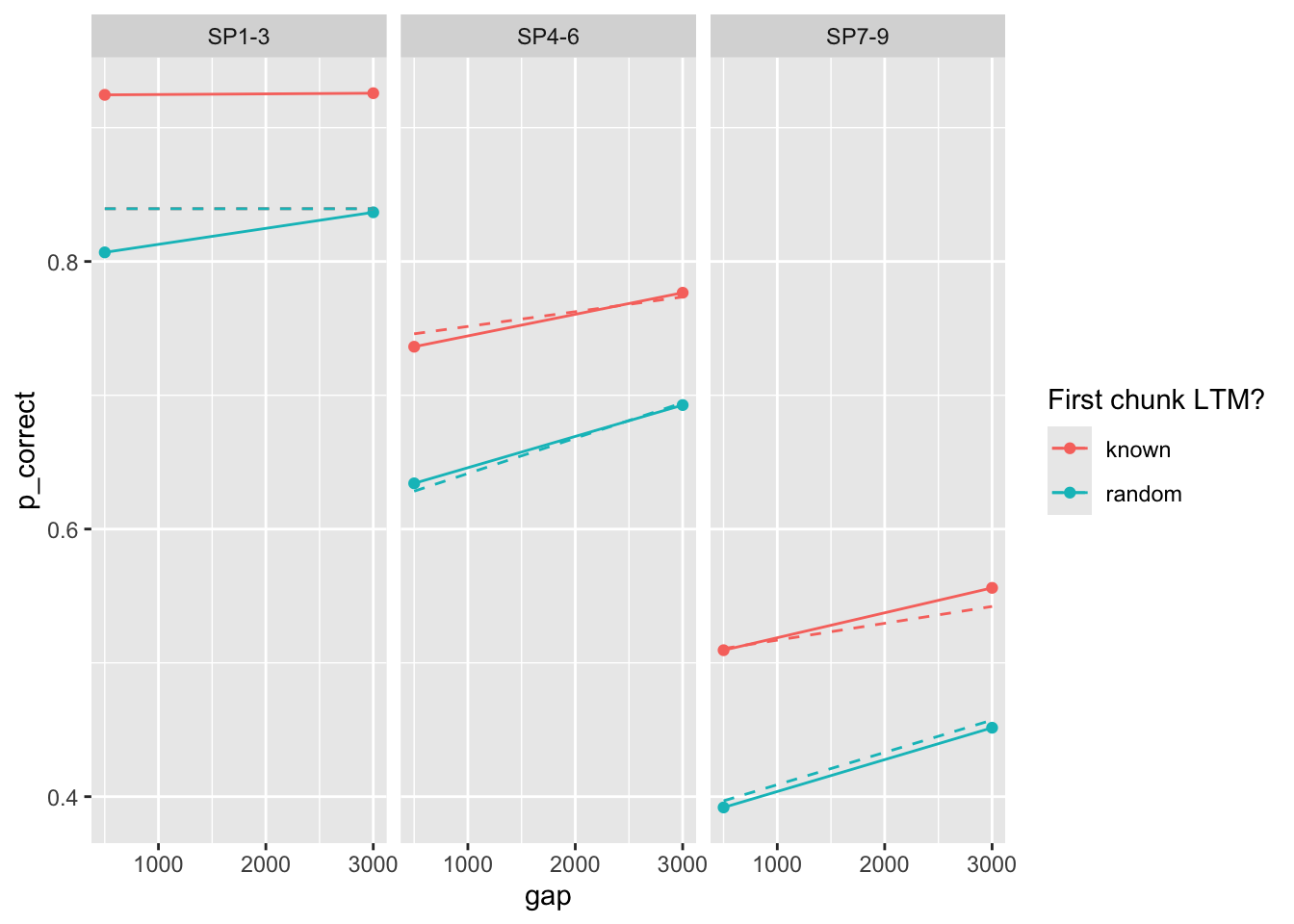
Fit the non-linear resource recovery model to the three experiments. Dashed lines are model predictions. Solid dots are the observed data and solid lines are linear regression lines.

Code
library(tidyverse)
library(targets)
library(GGally)
library(kableExtra)
# load "R/*" scripts and saved R objects from the targets pi
tar_source()
tar_load(c(exp1_data, exp2_data, exp1_data_agg, exp2_data_agg, exp3_data_agg))
set.seed(213)

Experiment 1

Code
start <- c(prop = 0.15, prop_ltm = 0.5, rate = 0.25, gain = 30, tau = 0.12)
est1 <- estimate_model(start, data = exp1_data_agg, exclude_sp1 = TRUE, growth = "asy")
exp1_data_agg$pred <- predict(est1, exp1_data_agg, group_by = c("chunk", "gap"), growth = "asy")
exp1_data_agg |>
  ggplot(aes(x = gap, y = p_correct, color = chunk)) +
  geom_point() +
  geom_line() +
  geom_line(aes(y = pred), linetype = "dashed") +
  scale_color_discrete("First chunk LTM?") +
  facet_wrap(~itemtype)
Experiment 2

Code
est2 <- estimate_model(est1$par, data = exp2_data_agg, exclude_sp1 = TRUE, growth = "asy")
exp2_data_agg$pred <- predict(est2, exp2_data_agg, group_by = c("chunk", "gap"), growth = "asy")
exp2_data_agg |>
  ggplot(aes(x = gap, y = p_correct, color = chunk)) +
  geom_point() +
  geom_line() +
  geom_line(aes(y = pred), linetype = "dashed") +
  scale_color_discrete("First chunk LTM?") +
  facet_wrap(~itemtype)
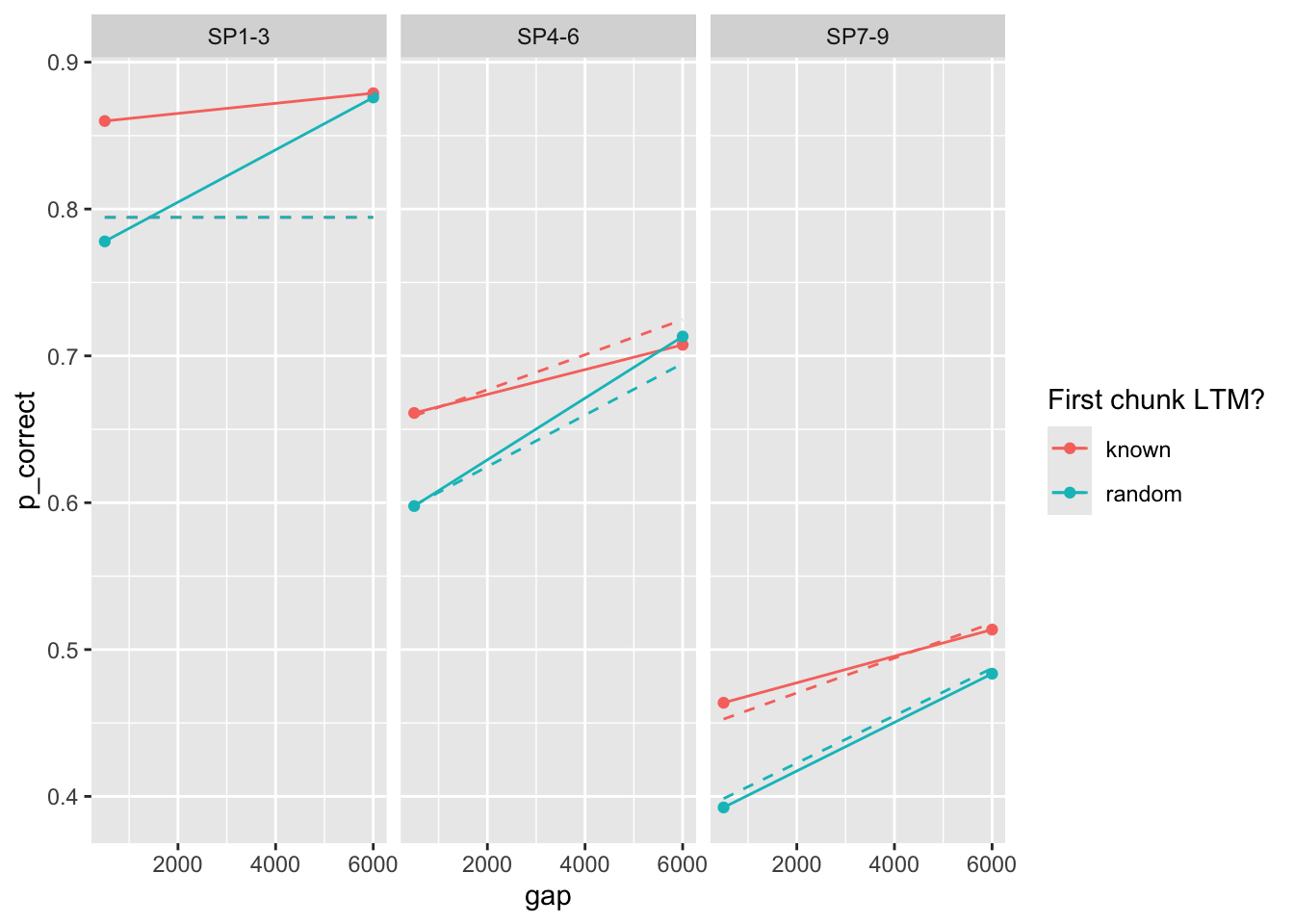
Experiment 3

Code
est3 <- estimate_model(est1$par, data = exp3_data_agg, exclude_sp1 = TRUE, growth = "asy")
exp3_data_agg$pred <- predict(est3, exp3_data_agg, group_by = c("chunk", "gap"), growth = "asy")
exp3_data_agg |>
  ggplot(aes(x = gap, y = p_correct, color = chunk)) +
  geom_point(alpha = 0.5) +
  stat_smooth(method = "lm", se = FALSE, linewidth = 0.5) +
  geom_line(aes(y = pred), linetype = "dashed", linewidth = 1.1) +
  scale_color_discrete("First chunk LTM?") +
  facet_wrap(~itemtype)
`geom_smooth()` using formula = 'y ~ x'
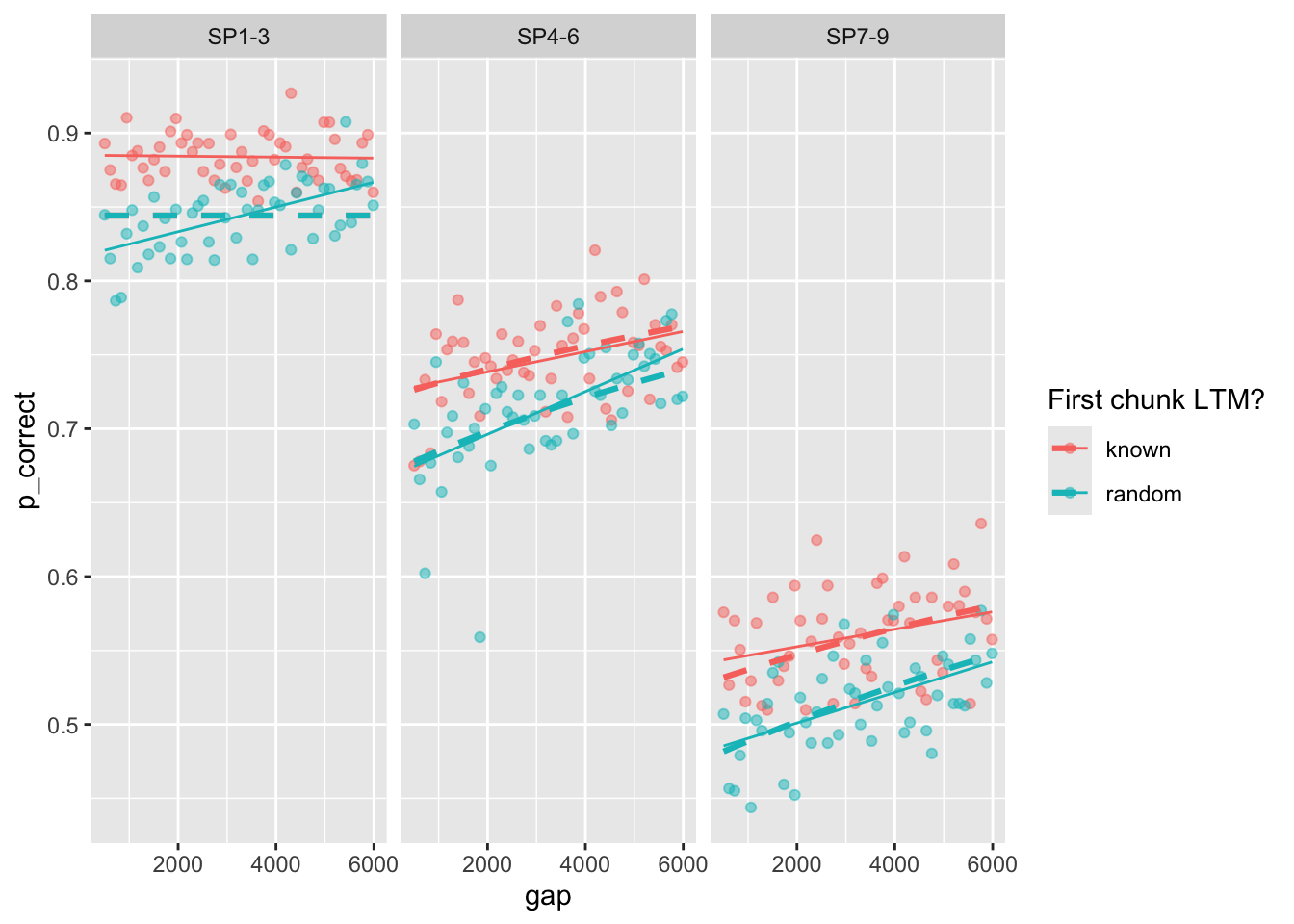
parameter estimates for the three experiments:

Code
kable(round(bind_rows(est1$par, est2$par, est3$par), 3)) %>%
  kable_styling()
prop prop_ltm rate gain tau
0.112 0.511 0.121 95.703 0.095
0.103 0.726 0.107 93.932 0.089
0.106 0.754 0.070 87.741 0.086

Summary

With the non-linear recovery model, we get rate estiates of 0.121, 0.107, 0.070 in the three experiments. Unlike the linear recovery rate, we cannot interpret these simply. But we can ask, given the resource recovery equation and these estimates, how long will it take to recover a proportion X of the resource from 0? This is equivalent to the equation

\[ 1-e^{-rate \times t} = X \]

solving for t gives

\[ t = -\frac{log(1-X)}{rate} \]

which we can plot:

Code
rdata <- expand.grid(
  X = seq(0.1, 0.9, 0.1),
  rates = round(c(est1$par["rate"], est2$par["rate"], est3$par["rate"]), 3)
)

rdata$time <- -log(1 - rdata$X) / rdata$rates

rdata |>
  ggplot(aes(x = X, y = time, color = factor(rates))) +
  geom_line() +
  scale_color_discrete("Rate") +
  labs(x = "Proportion recovered", y = "Time to recover")
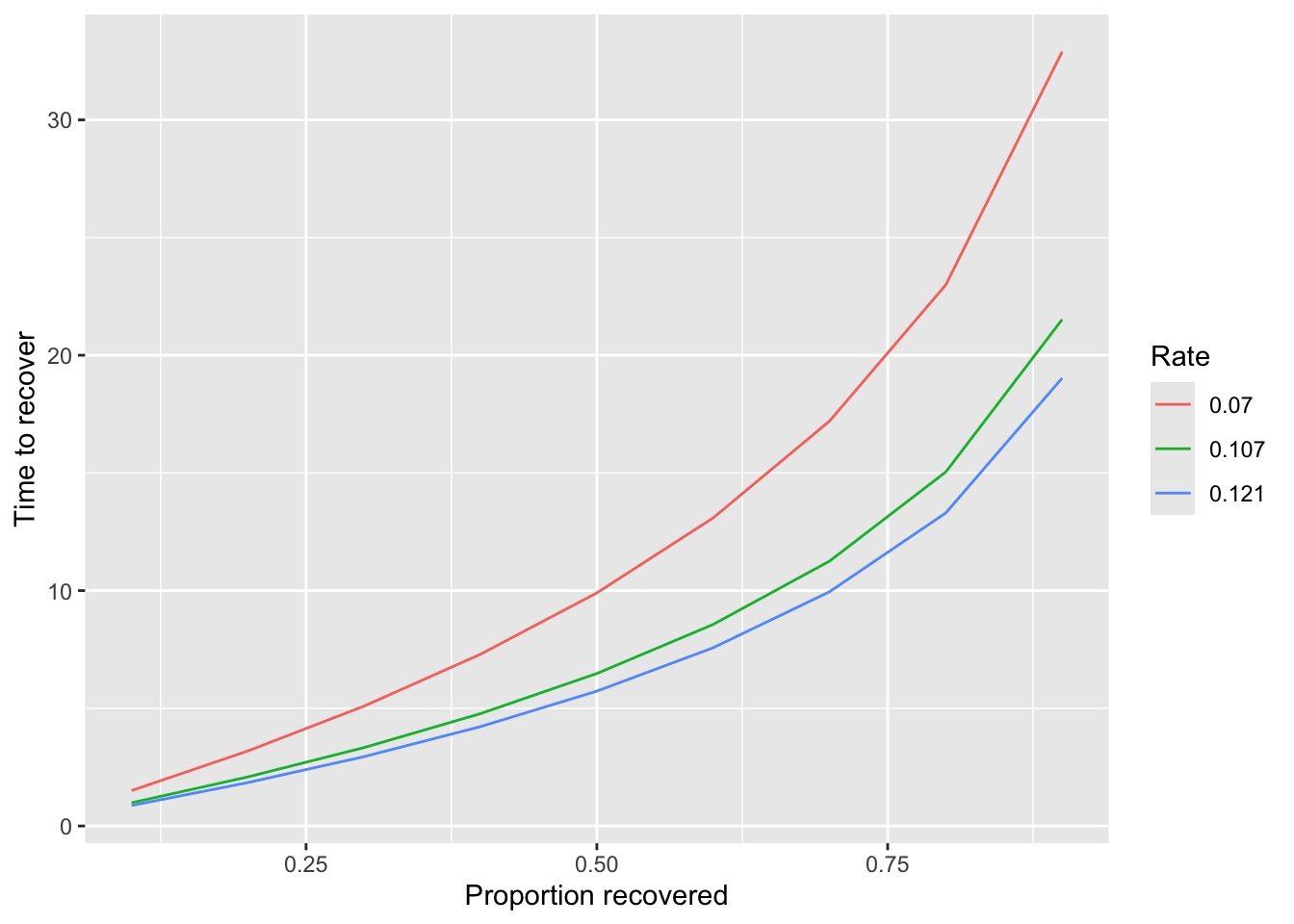
We see that it takes:

  • 2.50-4 seconds to recover 25% of the resource from 0 based on the estimates from the three experiments
  • 5-10 seconds to recover 50% of the resource from 0
  • 12-20 seconds to recover 75% of the resource from 0.
Back to top
Explore model predictions
Bootstrapping data and fits for parameter uncertainty estimation
Source Code
---
title: "Basic fits"
format: html
---

## Overview

Fit the non-linear resource recovery model to the three experiments. Dashed lines are model predictions. Solid dots are the observed data and solid lines are linear regression lines.

```{r}
#| label: init
#| message: false
library(tidyverse)
library(targets)
library(GGally)
library(kableExtra)
# load "R/*" scripts and saved R objects from the targets pi
tar_source()
tar_load(c(exp1_data, exp2_data, exp1_data_agg, exp2_data_agg, exp3_data_agg))
set.seed(213)
```

## Experiment 1

```{r}
start <- c(prop = 0.15, prop_ltm = 0.5, rate = 0.25, gain = 30, tau = 0.12)
est1 <- estimate_model(start, data = exp1_data_agg, exclude_sp1 = TRUE, growth = "asy")
exp1_data_agg$pred <- predict(est1, exp1_data_agg, group_by = c("chunk", "gap"), growth = "asy")
exp1_data_agg |>
  ggplot(aes(x = gap, y = p_correct, color = chunk)) +
  geom_point() +
  geom_line() +
  geom_line(aes(y = pred), linetype = "dashed") +
  scale_color_discrete("First chunk LTM?") +
  facet_wrap(~itemtype)
```

## Experiment 2

```{r}
est2 <- estimate_model(est1$par, data = exp2_data_agg, exclude_sp1 = TRUE, growth = "asy")
exp2_data_agg$pred <- predict(est2, exp2_data_agg, group_by = c("chunk", "gap"), growth = "asy")
exp2_data_agg |>
  ggplot(aes(x = gap, y = p_correct, color = chunk)) +
  geom_point() +
  geom_line() +
  geom_line(aes(y = pred), linetype = "dashed") +
  scale_color_discrete("First chunk LTM?") +
  facet_wrap(~itemtype)
```

## Experiment 3

```{r}
est3 <- estimate_model(est1$par, data = exp3_data_agg, exclude_sp1 = TRUE, growth = "asy")
exp3_data_agg$pred <- predict(est3, exp3_data_agg, group_by = c("chunk", "gap"), growth = "asy")
exp3_data_agg |>
  ggplot(aes(x = gap, y = p_correct, color = chunk)) +
  geom_point(alpha = 0.5) +
  stat_smooth(method = "lm", se = FALSE, linewidth = 0.5) +
  geom_line(aes(y = pred), linetype = "dashed", linewidth = 1.1) +
  scale_color_discrete("First chunk LTM?") +
  facet_wrap(~itemtype)
```

parameter estimates for the three experiments:

```{r}
kable(round(bind_rows(est1$par, est2$par, est3$par), 3)) %>%
  kable_styling()
```

## Summary

With the non-linear recovery model, we get rate estiates of 0.121, 0.107, 0.070 in the three experiments. 
Unlike the linear recovery rate, we cannot interpret these simply. But we can ask, given the resource recovery
equation and these estimates, how long will it take to recover a proportion X of the resource from 0? This is equivalent to the equation

$$
1-e^{-rate \times t} = X
$$

solving for t gives

$$
t = -\frac{log(1-X)}{rate}
$$

which we can plot:

```{r}
rdata <- expand.grid(
  X = seq(0.1, 0.9, 0.1),
  rates = round(c(est1$par["rate"], est2$par["rate"], est3$par["rate"]), 3)
)

rdata$time <- -log(1 - rdata$X) / rdata$rates

rdata |>
  ggplot(aes(x = X, y = time, color = factor(rates))) +
  geom_line() +
  scale_color_discrete("Rate") +
  labs(x = "Proportion recovered", y = "Time to recover")
```

We see that it takes:

-  2.50-4 seconds to recover 25% of the resource from 0 based on the estimates from the three experiments
-  5-10 seconds to recover 50% of the resource from 0 
-  12-20 seconds to recover 75% of the resource from 0